EN
Single Pair Lash Gift Box: Flip Lid and Heart Window — The 2026 OEM Guide
Single Pair Lash Gift Box: Flip Lid and Heart Window
Most gift boxes have a design applied to them. This one has a design cut into the part that moves.
The lid of this single-pair box carries a heart, and it is a cut, not a print. When the box is shut, that heart is a window: the pair of lashes sits in the base directly below it, so the box hands the product over through a shaped opening before anyone opens anything. And because the opening sits in the hinged part rather than on a fixed wall, it travels with the lid — the reveal is built into the mechanism instead of being added to the face.
That is the whole idea, and everything else about this box follows from it, including why the front panel can stay almost completely quiet.
👉Request a free sample of the lash gift box
Quick answer
The design principle worth taking from this box: put the opening in the part that moves, and the reveal becomes part of how the box works.
| Box state | What the heart does | What the customer sees |
|---|---|---|
| Lid shut | Window | The pair, framed by the shape |
| Lid opening | The frame lifts away with the lid | The pair, unobstructed |
Four consequences that shape the rest of the construction:
- The face can stay quiet. The cut is doing the visual work, so the wordmark sits as plain print beside it instead of competing with it.
- The aperture has to align with the product. The heart is only a window if the lashes are directly beneath it in the base.
- The closure has to be a gesture. A gift box is opened and closed many times, so it needs a lift-and-close action, not a tuck.
- The lid needs print on both sides. There should be something to read shut and open.
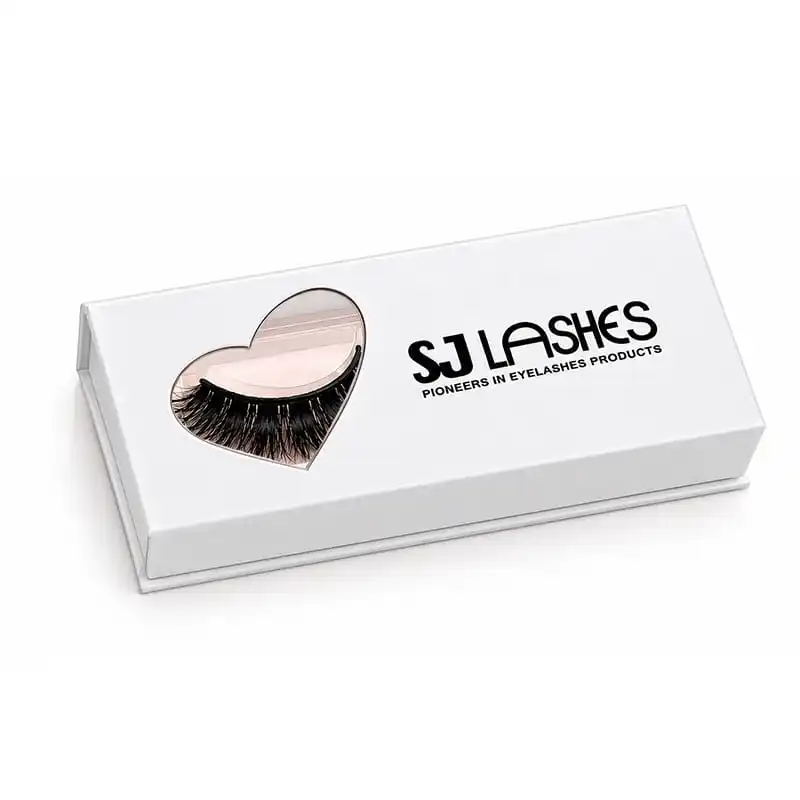
Image title: Shut, the Heart Is a Window
The lid is the design
It is worth being precise about why this works, because it is easy to copy the shape without copying the idea.
A heart produced as a print motif is decoration. A heart produced as a cut through the lid is a door. This box uses the cut, which means the shape is not a picture of a heart on a box — it is the opening through which the product is first seen.
That is what lets the front panel stay quiet. On this box the wordmark is set as plain print beside the heart, at ordinary size, with no foil and no ornament competing for the eye. The aperture is the feature; the branding steps back and lets it be.
The economy is the lesson: when one element is carrying the design, stop adding. A foiled heart, a printed heart pattern and a heart-shaped window on the same lid would each be weaker for the company of the others.
There is also a practical reason the cut-out belongs in the lid rather than in a fixed wall. A window in the box wall shows the product only while the box is shut and then stops mattering. A window in the lid stays with the customer through the whole opening action — it frames the product, lifts away with the lid, and gives the box an opening moment rather than just a printed face.
Anatomy of the flip lid
The lid is a flip lid hinged along the long edge. It closes down over the base so that its front edge overlaps the wall below, and it is held shut by magnets.
Four details make it work as a gift box rather than just a lid.
The hinge runs along the long edge, not the short. Opening it is a small, natural lift rather than a swing across the face, which suits a box that gets reopened.
The front edge overlaps the wall. An overlapping edge gives the closed box a clean, uninterrupted front face — which matters here, because a front face broken by a lid seam would compete with the heart.
Magnets, not a tuck. The lid opens with a lift and shuts with the same gesture. No tab to bend, no slot to find, no flap to fray. For a box that is opened and closed far more than once, that is not a luxury detail, it is the difference between a box that survives being gifted and one that looks tired by the second opening.
Print on both sides of the lid. Wordmark and tagline outside; the same mark repeated inside. There is something to read when the box is shut and something to read when it is open — and the inside print is also what keeps the lid interior from reading as blank space where the customer is now looking.
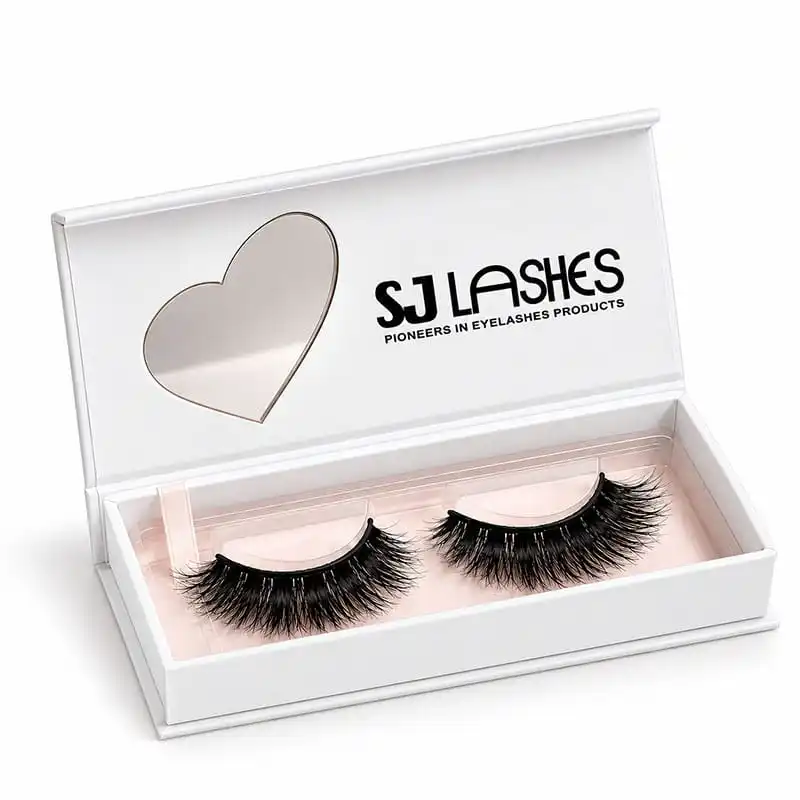
Image title: Open — Lid Interior Print and the Pair in the Lined Base
Closing it: a gift box needs a gesture, not an operation
This is the part that most single-pair boxes get wrong, and it is worth stating plainly.
A retail box is closed once, by your packer. A gift box is closed repeatedly, by the customer. The closures that work for one are wrong for the other.
A tuck flap is cheap and reliable and completely correct for a retail carton that will be opened once. Put the same tuck on a gift box and the customer bends it back the first time, creases it the second time, and by the fifth opening the tab is soft and the box does not stay shut. The box was not badly made; it was designed for a different number of openings.
Count the openings before you choose the closure. If your product is expected to be reopened, budget for a magnetic closure with a hinged lid. If it will be opened once and discarded, a tuck flap is the right answer and cheaper.
The magnet count is a specification worth setting deliberately. One magnet can allow the lid to twist; two set along the front edge hold the face square. Confirm the count on your sample rather than assuming it.
One dieline, three variants
The construction covers a whole range from a single structure, which is a commercial point as much as a design one.
- Kraft, plain lid. Natural kraft board, wordmark printed on the lid interior, no window.
- Kraft, clear window in the lid. The same kraft box with a rectangular clear window set into the lid, with PVC film, so the pair is visible when the box is shut.
- White, heart cut-out. White board with the heart aperture cut through the lid.
Because all three share the panel structure, a brand can start with the simplest and move up without commissioning a new dieline. That matters at launch: the variant you ship first is rarely the variant you ship in year two, and a shared structure means the change is an option, not a redevelopment.
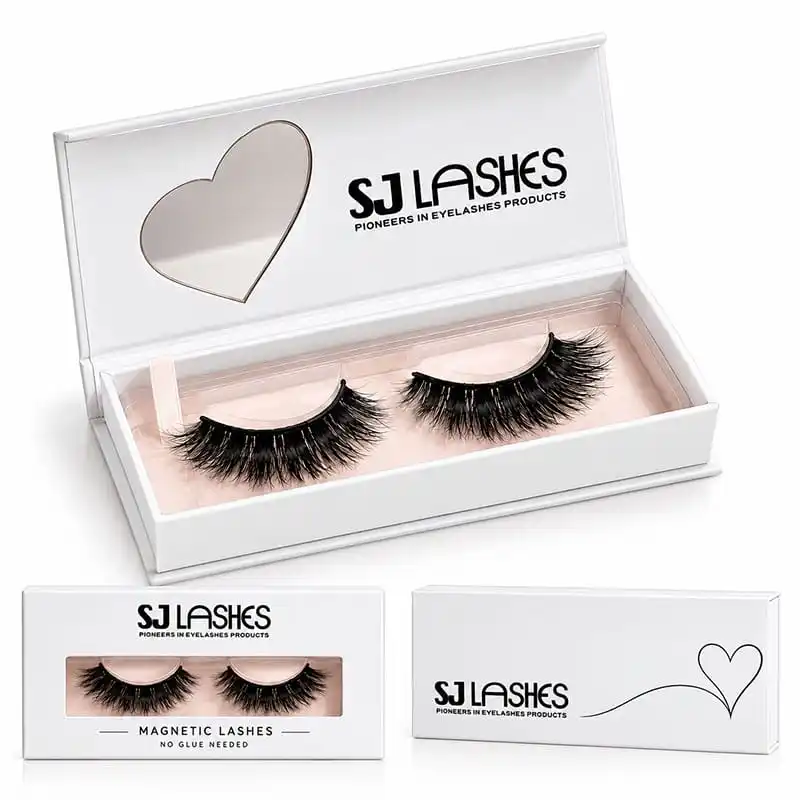
Image title: One Structure, Three Variants — Kraft, Kraft with Window, White with Heart
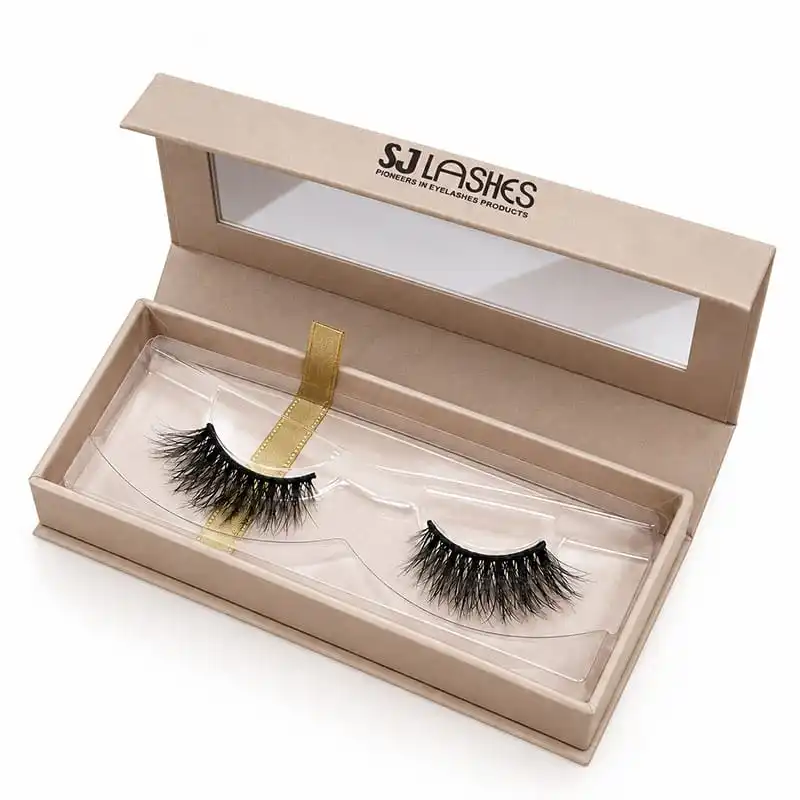
Image title: Kraft With a Clear Window — Same Structure, Different Ground
The base: tray, insert and pull tab
The base is where the alignment requirement lives, because the heart is only a window if the product is directly beneath it.
The insert tray holds one pair in a clear formed tray, each lash on its own pad, positioned so that the pair sits under the aperture when the lid closes. Get this placement wrong by a few millimetres and the heart shows tray instead of lash — which is why the tray position is a specification, not a detail.
The liner is a separate specification. The white version is shown with a pale pink liner, which lifts the dark lashes and makes the pair read clearly through the aperture. Liner colour and material are both customizable, and this is one of the cheapest places to put brand colour.
The kraft version adds a gold ribbon pull tab running under the tray, so the tray can be lifted out rather than levered at an edge with a fingernail. It also happens to be the one warm accent on an otherwise neutral box.
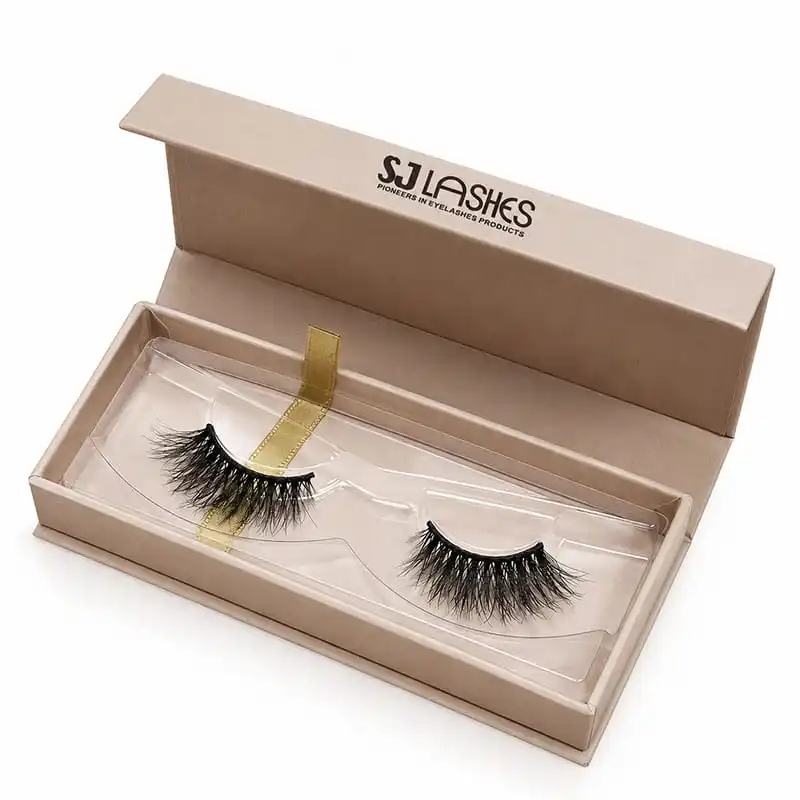
Image title: The Ribbon Gives the Tray Its Own Way Out
The cards: one printed, one blank
The full set adds two cards in the base, and the pairing is the interesting part.
One printed lash card carries the product information — style, length, whatever the brand needs to state.
One left blank for a written note.
The blank card is the one worth copying. A gift box is usually bought by one person for another, and a blank card is the box handing the giver a voice. It costs a piece of card and a slot in the tray, and it converts a product into a gift. It also gives you a place to put care or removal information without adding another printed panel.
If you sell the box as a gift, print one card and leave the other empty. If you sell it as retail, print both.
Customization options
- Ground — kraft or white paperboard, and board grade.
- Lid aperture — no window, a clear rectangular window with PVC film, or a custom cut-out shape such as the heart.
- Mirror — an optional mirror element, specified separately from the lid aperture, or omitted.
- Surface finish — matte, gloss or soft-touch lamination.
- Print finishing — CMYK or Pantone spot for brand colour, hot foil in gold, silver or rose gold, spot UV, debossing and embossing.
- Closure — magnetic closure and magnet count.
- Lid inner print — the mark repeated inside, and its placement.
- Liner and tray — colour and material of the liner, tray form and pad layout.
- Cards — a printed card, a blank note card, or both, and their print.
- Ribbon or pull tab — fitted or omitted.
- Pair count — single pair as standard, with the tray adjusted for other counts.
- Panel wording — and the wordmark treatment.
The heart on the lid can be swapped for your own motif. Low MOQ with fast sampling for a first run.
Explore our strip lashes gift boxes, magnetic lashes and all-in-one packaging ranges, or see the photography and video services we use for gift-box launch imagery.
Supplier scorecard and sampling
What to ask
- Will the lid hinge along the long edge or the short edge, and how many magnets hold it?
- Can you confirm the tray position holds the pair directly under the aperture when the lid is closed?
- Does the same dieline cover the kraft and white versions, the clear window option and the heart cut-out?
- Can the aperture be cut to our own motif rather than a heart, and what does a new cut-out cost?
- If we take the clear window option, what film thickness do you use and how is it set into the lid?
- Can the lid interior carry print on the same run?
- Can the set include one printed card and one blank card?
What to check on the sample
- The alignment test. Close the empty box and look through the aperture. Then load a pair and close it again. If you can see tray rather than lash, the tray position needs moving.
- The closing test. Open and close the box twenty times in a row. The lid should still sit square, the magnets should still hold, and nothing should have creased.
- The aperture edge test. Run a finger around the cut. A shaped cut-out should be clean and finished, with no exposed board edge that will fray with handling.
- The transit test. Ship a loaded box. Confirm the lid arrives square and the pair has not shifted out from under the opening.
- The liner contrast. Look at the loaded box through the aperture. A liner colour that looks good flat may make the lashes disappear through a cut-out.
- The gesture test. Hand the box to someone who has not seen it and watch how they open it. If they look for a tab, the closure is wrong.
- The card slots. Confirm both cards sit in the base without lifting the tray or pressing on the lashes.
Channel notes
Gifting and seasonal. This is the box's clearest home. The blank card, the magnetic closure and the shaped opening all point at a box bought for someone else, and the aperture gives a giftable object a visible product without opening it.
Beauty retail. A single-pair box at a gift price point works on a counter where a multi-pair pack would not, and the heart aperture does the shelf work that a flat printed panel cannot.
Bridal and event. Single pair, personal note, a shaped opening — the format suits bridal parties and event gifting, and it is one of the few lash formats that reads as a keepsake rather than a consumable.
E-commerce and social. The shut box and the opening box are two genuinely different photographs from one product: the aperture shot, and the shot where the lid is lifting away from the pair. That is a strong listing pair, and it is the reason the lid carries print on both sides.
Where it does not fit. High-volume multi-pair retail, where unit cost dominates and a folding carton will always win. Use this box where the opening is part of the product.
OEM workflow
- Decide the job of the aperture — product visibility, and whether it is a plain window or a shaped cut-out.
- Fix the hinge edge and the magnet count on the sample, not in the drawing.
- Set the tray position from the aperture, then confirm it with a loaded box.
- Choose the ground and the variant — kraft plain, kraft with a clear window, or white with the cut-out.
- Finish the cut edge and confirm it survives handling.
- Place print on both sides of the lid, and check the inside print uses the space well.
- Decide the cards — one printed, one blank, or both printed.
- Run the twenty-openings test and the transit test before committing to the run.
Quote request checklist
- Target market and channel.
- Ground — kraft or white — and board grade.
- Lid aperture — none, a clear rectangular window, or a custom cut-out shape.
- Film specification, if a clear window is used.
- Hinge edge and magnet count.
- Surface finish and lamination.
- Print finishing, including any foil, and brand colour references as Pantone spot values.
- Lid interior print and its placement.
- Liner colour and material, and tray form.
- Cards — printed, blank, or both — and their content.
- Ribbon or pull tab, fitted or omitted.
- Pair count.
- Panel wording and wordmark treatment.
- Sample quantity, first order quantity, and delivery window.
👉Request a free sample of the lash gift box
Compliance and honest claims
- Be precise with the "no glue" message. A magnetic lash system genuinely does not use lash glue, so "no glue needed" is an accurate description. But it still needs a magnetic liner, which is a liquid cosmetic. If the pack reads as though no liquid is involved at all, the customer's first disappointment arrives at the point of use. State the system plainly and list what is required.
- Label the liner, not the box. The magnetic liner carries the ingredient declaration, batch coding and market-specific language requirements. The gift box is not the place for them.
- Check every component before making an environmental claim. A paperboard box with a clear plastic window, or with any non-paper insert, is not wholly paper. If you make an environmental claim, make sure it is accurate for the whole pack, not just the board — this is the same test that catches most eco-claims in this category.
- If a mirror is specified, treat it as a component in the same test. A fixed mirror is a non-paper element and a mass inside a hinged lid; confirm it arrives intact after a realistic shipping cycle and that its fixing does not fail if the lid is flexed.
- Keep the pair count accurate. If the box is specified as a single pair, the count on the panel and the tray should agree.
- Say what the blank card is for. A blank card is a lovely thing, but a line on the outer panel explaining that the box includes a card makes it a feature rather than a mystery.
- Substantiate a "reusable" claim if you make one — the box being reusable is a different claim from the lashes being reusable, and they should not be blurred.
Requirements differ between markets. Confirm the final content and claims for your target market with your compliance adviser before the print run.
Why SJ LASHES
- Gift box structures built around a hinge, with magnetic closures and lid apertures developed as one construction rather than assembled from parts.
- Cut-out apertures finished properly — a shaped cut such as the heart needs a clean, finished edge, not just a die strike.
- One dieline covering the range — kraft plain, kraft with a clear window, and the white heart version — so a brand can move up the range without a new structure.
- Insert tray engineering that positions the product under the aperture, which is the specification the whole design depends on.
- Print on both sides of the lid, with the interior print set to use the space the opening frames.
- Full finishing range — CMYK and Pantone spot, hot foil, spot UV, embossing and debossing, matte, gloss and soft-touch lamination.
- Card production, including a blank note card slotted into the tray.
- Strip lash and magnetic lash manufacturing alongside the packaging, so the tray, the pair and the box are specified together.
- Low MOQ with fast sampling for a first run.
See our strip lashes gift boxes, strip lashes paper boxes, magnetic lashes, all-in-one packaging and FAQ pages.
FAQ
What makes this a gift box rather than a retail box?
Two things: the closure and the opening. The lid hinges along the long edge and is held by magnets, so it opens with a lift and shuts with the same gesture — a gift box gets reopened many times and a tuck flap will not survive it. And the heart is cut through the lid rather than printed on it, so the box has an opening moment instead of just a printed face.
Why cut the opening into the lid instead of printing a heart on it?
Because a print is decoration and a cut is an opening. Printed, the heart is a picture of a shape on the box. Cut through the lid, it is the aperture the product is seen through, and it is what lets the rest of the face stay quiet — the wordmark can be plain print beside it instead of competing with it.
Can we have a clear window instead of a shaped cut-out?
Yes, and the two do different jobs. A clear rectangular window is the simplest way to show the pair when shut and keeps the board stronger, with PVC film set into the lid. A shaped cut-out such as the heart is the design feature itself. If the opening is meant to be the idea, cut it. If it is just to show product, use a clear window.
Does the cut-out need film?
The straight answer is that it depends on what the opening is for. A clear rectangular window normally carries PVC film to protect the lashes and to keep the shape rigid. A shaped cut-out is often left open so the product is seen with nothing between it and the eye. Decide which you want before sampling, because it changes the lid construction.
Can the heart be changed to our own shape?
Yes. The heart is a cut-out in the lid, so it can be replaced with your own motif. Bear in mind that a cut-out has to align with the product underneath it — the more complex the shape, the more carefully the tray position has to be set.
How many magnets should the lid have?
Enough to hold the face square. A single magnet can allow the lid to twist, so two set along the front edge is the safer specification. Confirm the count on a physical sample rather than assuming it.
Why does the kraft version have a ribbon pull tab?
So the tray has its own way out — the ribbon runs under it, so the customer lifts it rather than levering at an edge with a fingernail. It also gives a neutral kraft box its one warm accent.
What is the blank card for?
It is for the giver. A gift box is usually bought by one person for another, and the blank card lets them write their own note. It costs a piece of card and a slot in the tray, and it is the difference between a product and a present. The set pairs it with a printed card carrying the product information.
What is the minimum order for a custom single-pair lash gift box?
It depends on the structure, the aperture, and how much print is custom. Share your component list and target quantities and we will confirm what is achievable for a first run.
Final thought
The clever part of this box is not the heart. It is that the heart is a cut, in the part of the box that moves.
Print a shape on a fixed wall and it is decoration. Cut the same shape through the lid and it becomes the aperture the product is seen through — and because it travels with the lid, the reveal belongs to the mechanism rather than to the face.
Design the moving part, and the fixed parts can stay quiet. Then count the openings before you choose the closure, and leave one card blank.
👉Request a free sample and quote from SJ LASHES
For more packaging development, factory footage and application education, follow SJ LASHES on Instagram and read the SJ LASHES blog.