EN

Single Row Lash Packaging: 8 Clusters, One Look (2026)
A row is a different product from a tray
Most lash packaging we are asked to quote holds a grid: ten rows, five rows, seven rows split into left eye and right eye. Single row lash packaging is the exception: this one holds youa line — a single row of clusters, eight of them, side by side on a strip.
That difference looks small and is not. A grid is a menu: the customer chooses how many clusters to use and builds the density herself. A line is a decision already made. One row, one look, no assembly required — which is why this format is used for single-look SKUs, for trial sizes, and as the retail add-on a lash tech hands over at the end of an appointment.
The consequence is that the packaging carries a different burden. It has almost nothing to explain, so it has to be right about one thing: the row.
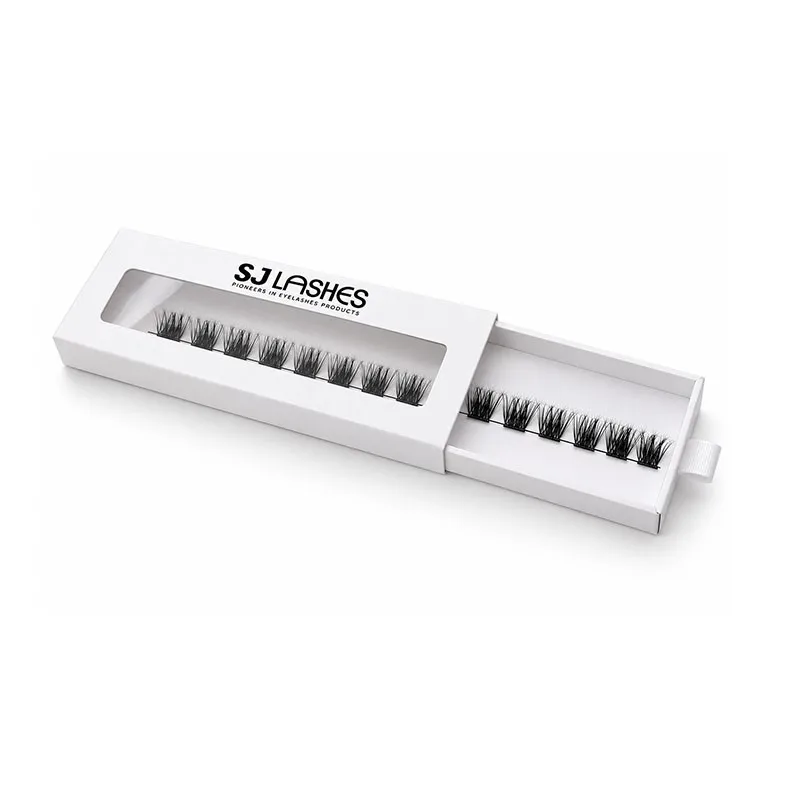
One Row, Eight Clusters, One Window
Quick answer
| Question | Answer for this format |
|---|---|
| What it is | A one-row segment lash pack in a paper box with a paper tray |
| What is inside | A single row of clusters — eight in the photographs here |
| The two constructions | Slide-out drawer in a sleeve; top-window carton with a sliding tray |
| Where the window goes | In the sleeve, or in the top panel — and that choice changes the whole box |
| The real engineering problem | Making the row sit in the aperture every time the box is closed |
| Best for | Single-look SKUs, trial sizes, salon retail add-ons |
The row count is the product
Eight clusters is not a quantity, it is a claim about a look. Split across two eyes it is four per eye, and whether that is a light natural set or an almost-invisible one depends on the cluster width — which is why a one-row pack should state its cluster width and its count, not just its length in millimetres.
There is a merchandising point underneath this. In a multi-row kit, the customer's question is "which density do I want?" In a one-row pack there is no density to choose, so the customer's question becomes "what does this look like on?" — and the answer has to come from the photograph, the model shot and the count.
That is also the honest limit of the format. A single row cannot sell variety, and it cannot serve a customer who wants to build a heavier look. If your range needs to cover both, the one-row pack sits next to a multi-row kit as a different product, not as its smaller size.
The registration problem
Here is the thing that decides whether this box looks expensive or cheap, and it is not the print.
A one-row pack is a long, thin aperture and a long, thin tray. The window is narrow. Which means the row has to land in the same place every single time, because there is no slack in a 10mm-tall opening: two millimetres of drift and one end of the row is clipped by the window edge.
That is a registration problem, and it has three causes worth knowing:
1. The drawer has no stop. A sliding tray pushed into a sleeve will always find its own resting depth — sometimes 2mm short, sometimes 3mm deep, because a paper sleeve has tolerances and paper has memory. In the closed position the row can end up off-centre in the aperture. The fix is a stop: a shoulder on the tray, a fold, or a ribbon that is stitched at a fixed length so the drawer cannot travel past its position. Note that the white ribbon pull tab in these photographs is doing double duty — pull, and stop.
2. The tray is not located laterally either. A thin tray in a thin sleeve can shift left and right by a millimetre or two, and on a long thin window that reads as the product being off-centre.
3. The clusters are not fixed to the tray. If the row sits loose in the recess rather than on a strip or in a channel, it will slide with every tilt — and the customer opens the box to find the row bunched at one end. Which is the difference between "sample" and "shipped product".
A test that finds all three: pack a box, then carry it in a bag for a day, then open it and look. Not a shake test — a carry test. Shaking finds loose parts; carrying finds drift.
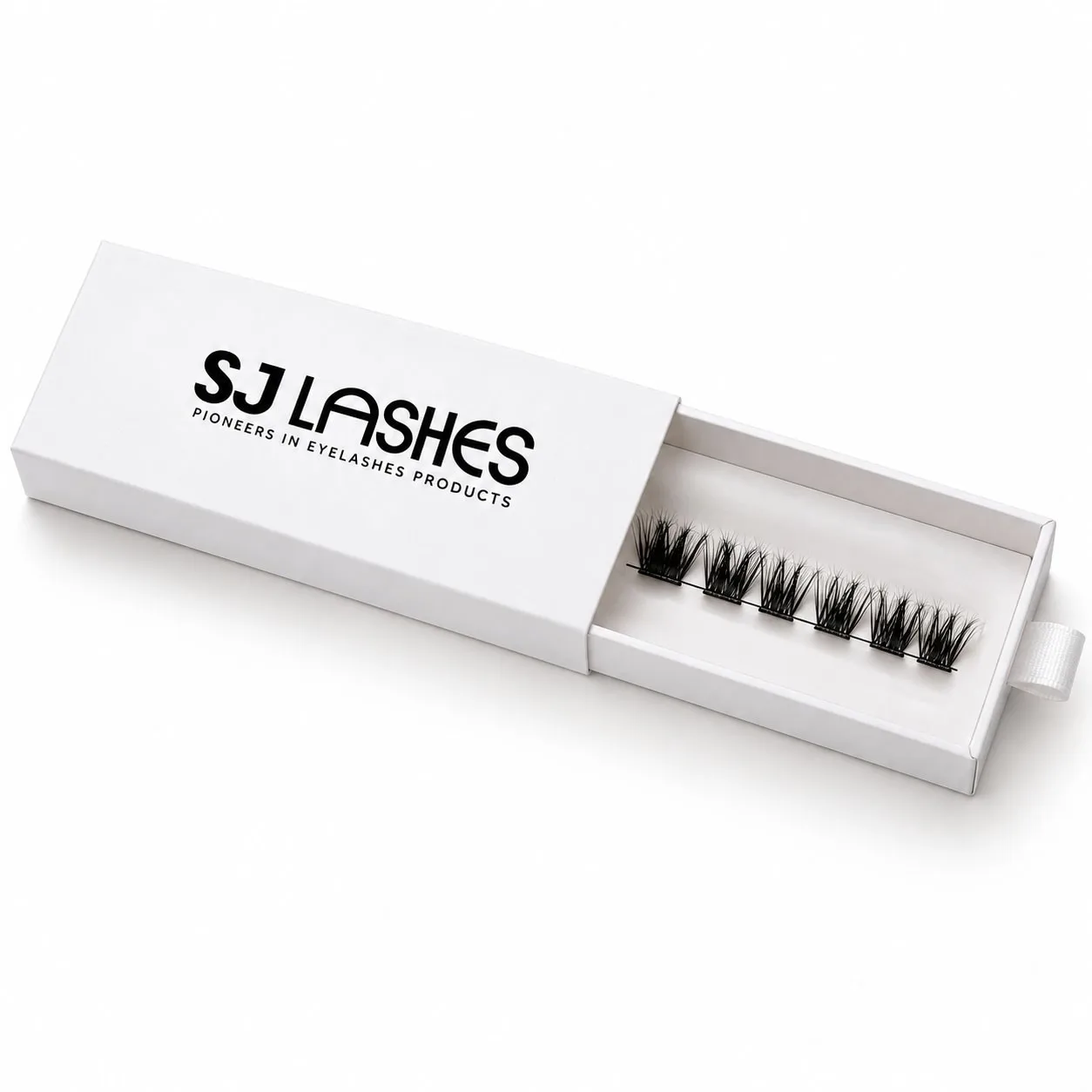
The Ribbon Is a Pull Tab and a Stop
Why the window has a printed outline
Look closely at this second construction and you will notice something easy to miss: the window has a thin printed rule running around it, inside the cut edge, and it is not there to decorate.
On a white box with a white tray and a die-cut aperture, the window has no visible edge. The board face, the aperture wall and the white tray behind it are all close to the same tone, so the eye reads one undifferentiated white area and the aperture effectively disappears — the product floats. A printed rule gives the opening a boundary, and the moment it has a boundary the client reads it as a frame around the product rather than a hole someone forgot to fill.
The same trick appears in a different form on the sleeve version: there, the sleeve's edge and the shadow line of the drawer do the framing, which is why that box does not need the printed rule. One construction earns its frame from print; the other earns it from depth.
A practical note on the rule. It has to sit inside the cut edge with enough clearance to survive a cutting tolerance — a rule printed flush to the die line will wander or get partly chopped on some units, and the inconsistency reads as poor print registration even when the print is perfect.
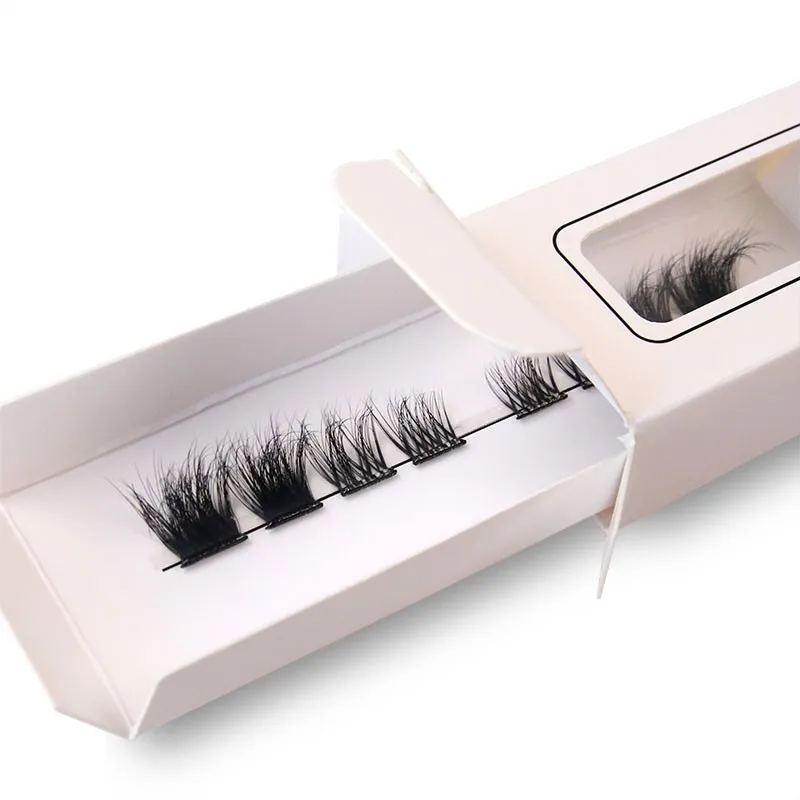
A Printed Rule Is What Makes a White Window Read
Two constructions, one decision
The photographs here show the same product in two boxes, and the choice between them is a single question: where should the reveal happen?
The slide-out drawer, window in the sleeve. The box stays closed and the customer sees the row through the sleeve; pulling the drawer adds a second reveal, because the tray that was behind the window now comes out into the hand. Two reveals for one product, and the ribbon does the inviting. This is the version to choose when the pack has to work face-up on a shelf and still feel like an event.
The top-window carton with a sliding tray. The window is in the top panel, so the product is read from above — the box lies flat, or stands in a shallow tray. Here the printed rule does the framing, and the opening flap and the sliding tray do the reveal. This is the version for stacked retail display, for sets laid out on a counter, and for anything sold lying down.
There is a cost difference, and it is not where people expect. The drawer version has more parts — a sleeve, a tray, a ribbon — and the ribbon has to be attached. The top-window version is fewer parts but needs a stronger board in the panel that carries the window, because that panel is the one that gets handled.
What both versions share is the tray. Change the box and the tray survives, which is worth knowing before you commit to tooling: the tray is the part that touches the product, and it is the part you should be slowest to change.
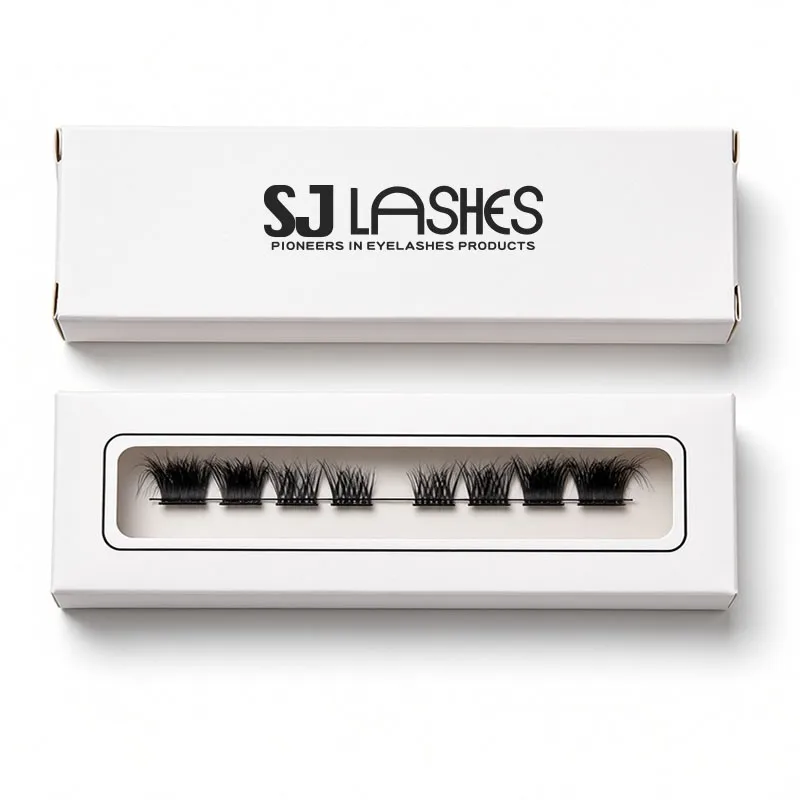
Same Tray, Two Boxes — Window and No Window
What the paper tray is actually doing
A one-row tray looks like the simplest part in the box — a folded sheet with a recess — and it is doing three jobs at once.
It holds the row in line. The recess runs the length of the tray so the row cannot fan or bend. That matters more here than in a grid, because a single row has nothing on either side of it: in a ten-row tray a bent row is held roughly straight by its neighbours, and in a one-row tray it is held by the recess or not at all.
It sets the depth. The clusters sit at a height where the closed box does not press on the tips. Paper trays are folded from thin board — typically around 1mm — and the recess depth is built from layers, so the depth is a folding decision, not a moulding one — which makes this format cheap to change early and awkward to change late. If you change cluster length after the tray is drawn, the depth no longer matches.
It is the part that arrives flat. This is the commercial reason paper beats plastic in a thin pack: trays ship flat or nested, take almost no volume, and can be assembled at the packing line. On a long thin box, that is the difference between a carton that is mostly air and one that is mostly product.
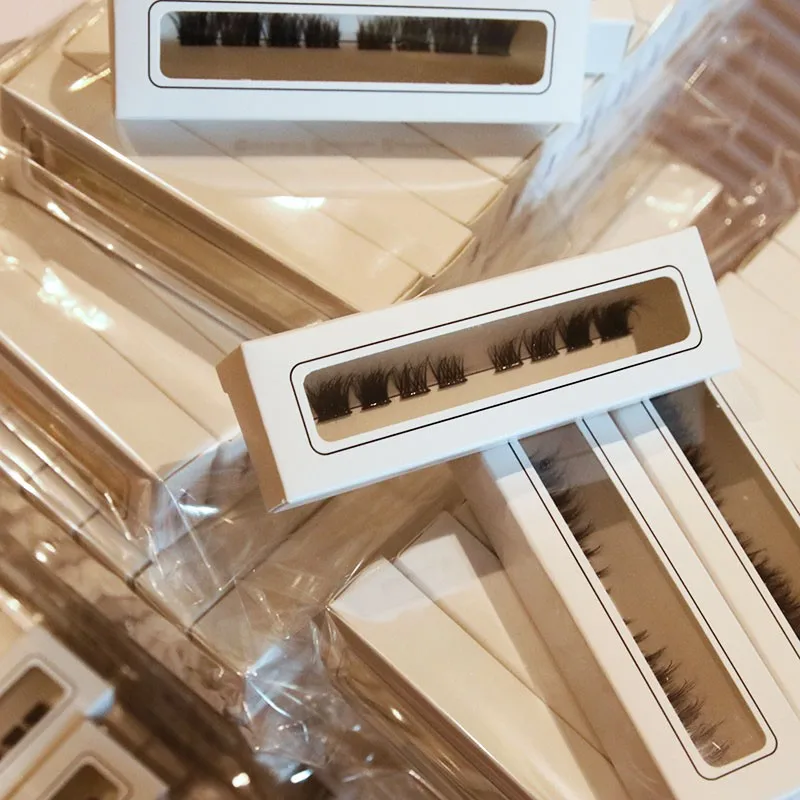
Flat Tray, Thin Box, Dense Carton
When one row wins, and when it does not
- Wins: a single-look SKU. One row, one look, one decision. Best when the brand wants a signature style rather than a menu.
- Wins: a trial or sample price point. A short row at a low unit price lets a customer try the product before committing to a multi-row kit.
- Wins: salon retail. A lash tech can hand this over with the appointment; it is small, cheap to stock and reads as a considered add-on.
- Wins: gift-with-purchase and subscription inserts. Thin, flat and light, which is exactly what a mailer needs.
- Does not win: a customer building density. A single row cannot be layered, so anyone wanting a heavier look needs a multi-row pack.
- Does not win: cost per cluster. One row in its own box costs more per cluster than ten rows in one box — the box, tray and print are spread over eight clusters instead of eighty. If the pack is a volume play, do the arithmetic before falling in love with the format.
That last point is the one most often missed. A one-row pack is a positioning decision that happens to be small, not a cheap version of a big kit.
Supplier scorecard
What to ask
- Is there a stop in the closed position, and what stops the drawer travelling too far?
- How is the tray located laterally inside the sleeve?
- What holds the row in the recess — a strip, a channel, or nothing?
- What is the recess depth, and what cluster length is it cut for?
- Is the window rule printed with clearance from the die line, and how much?
- What board grade carries the windowed panel?
- Where is the ribbon attached, and is it also the stop?
- What changes if I want the same tray in the other construction?
What to check on a sample
- Carry test. Pack it, carry it in a bag for a day, open it. The row should be where you left it.
- Closed-position test. Close the box twenty times without looking at the window, then look. If the row is not centred, there is no stop.
- Drift test. Hold the closed box at an angle and shake gently. The row should not slide along the recess.
- Depth test. Close the box and press the panel over the row. You should feel the board stop on the tray, not on the cluster tips.
- Edge test. Run a finger along the window rule. Any rough or wandering edge is a cutting clearance problem, not a print problem.
- Flat-pack test. Ask for the tray flat before assembly and check it folds square — a tray that folds out of square cannot register.
Quote checklist
- Construction: slide-out drawer in a sleeve, or top-window carton with sliding tray.
- Box dimensions and board grade.
- Window: none, sleeve window, or top-panel window — with or without a printed rule.
- Tray: board grade, recess depth, cluster length range it is cut for.
- Row configuration: cluster count, cluster width, lengths included.
- Closure: ribbon pull, stop, or both.
- Print: front, back, and any panel that carries compliance text.
- Carton and pallet configuration.
- Sampling quantity and lead time.
👉Request a sample of our one-row lash boxes
Compliance and honest claims
- A thin box still has to carry the label. Product name, net content, the responsible party and any required warnings have to fit on a small panel or a small back. Space for them belongs in the artwork brief, not in a late revision.
- Language is a market decision. If this pack sells into a market with a labelling language requirement, that requirement applies to a small box exactly as it applies to a large one — and a small box has less room to satisfy it.
- State the count and the width, not just the length. "8 clusters" and the cluster width are what a buyer can actually verify. A length in millimetres alone does not tell her what the look will be.
- Do not claim a set count you have not checked. If the pack says it makes a certain number of sets, that figure has to survive a count of a packed unit.
- Paper is not automatically "eco". A paper tray replacing plastic is a real reduction and a legitimate point — but a blanket recyclability or sustainability claim needs to cover the whole pack, including any film, ribbon and adhesive, to stand up.
Why SJ LASHES
A one-row pack is decided by millimetres. The row has to land in the aperture, the recess has to match the cluster, and the closure has to hold both of those for fifty openings — and none of it shows in a render.
- We build the tray before the box. The recess is cut to the cluster we are actually packing, so the depth matches the product rather than a template.
- We design the closure as a mechanism. Stop, ribbon and tray shoulder are one decision, because a stop that is an afterthought is a drawer that drifts.
- We print the window for the box it sits in. On white board, a rule with proper die clearance — or no rule at all, when the construction's own shadow does the framing.
- We quote both constructions against the same tray. You see the cost of the window and the ribbon as a line, not as a guess.
- Low minimums and fast sampling. Everything that fails in this format — drift, clipping, a row that bunches — is visible in the hand and invisible in a drawing.
👉Talk to us about your one-row lash pack · See packaging options
Frequently asked questions
What is a one-row segment lash pack? A pack holding a single row of lash clusters on a paper tray, inside a paper box. In the photographs here the row carries eight clusters.
Is a one-row pack just a smaller multi-row kit? No. A multi-row kit is a menu the customer chooses from. A one-row pack is a look already decided, so it sells a style rather than a density — and it costs more per cluster, because the packaging is spread over fewer pieces.
Should the window be in the sleeve or in the top panel? Sleeve if the box has to work face-up on a shelf and you want the pull to be part of the reveal. Top panel if the pack is displayed lying down or stacked. The tray can stay the same either way.
Why does one version have a printed line around the window? Because on a white box with a white tray, a die-cut aperture has almost no visible edge. The printed rule gives the opening a boundary so the product reads as framed rather than floating.
Why does my drawer sit off-centre when closed? Almost always because there is no stop. A paper drawer finds its own resting depth, which varies unit to unit; a shoulder, a fold or a fixed-length ribbon cures it.
Can the tray be plastic instead? It can, and paper is usually the better choice in a thin pack: trays arrive flat or nested, take little volume in the carton, and can be assembled at packing. Plastic buys rigidity you rarely need at this size.
Does the ribbon do anything besides look nice? In a well-built drawer box it is also the stop. Attached at a fixed length, it limits travel so the row lands in the window every time.
What is the first test I should run on a sample? Carry it in a bag for a day, then open it. Shaking finds loose parts; carrying finds drift.
The takeaway
A one-row pack looks like the easy version of a lash box and is really the unforgiving one. There is no grid to hide a bent row, no slack in a thin window, and nothing to distract from a drawer that stops 2mm short.
Get three things right — a stop in the closed position, a recess cut to the actual cluster, and a window edge that reads on white board — and the box looks like a considered product. Miss any of them and the customer's first impression is that something is slightly off, without being able to say what.
👉Related reading: the three most popular lash box types · our guide to the DIY lash extension kit box