EN

DIY Lash Extension Kit Box: One Tray, Four Parts — The 2026 OEM Guide
The box that has to hold a whole routine
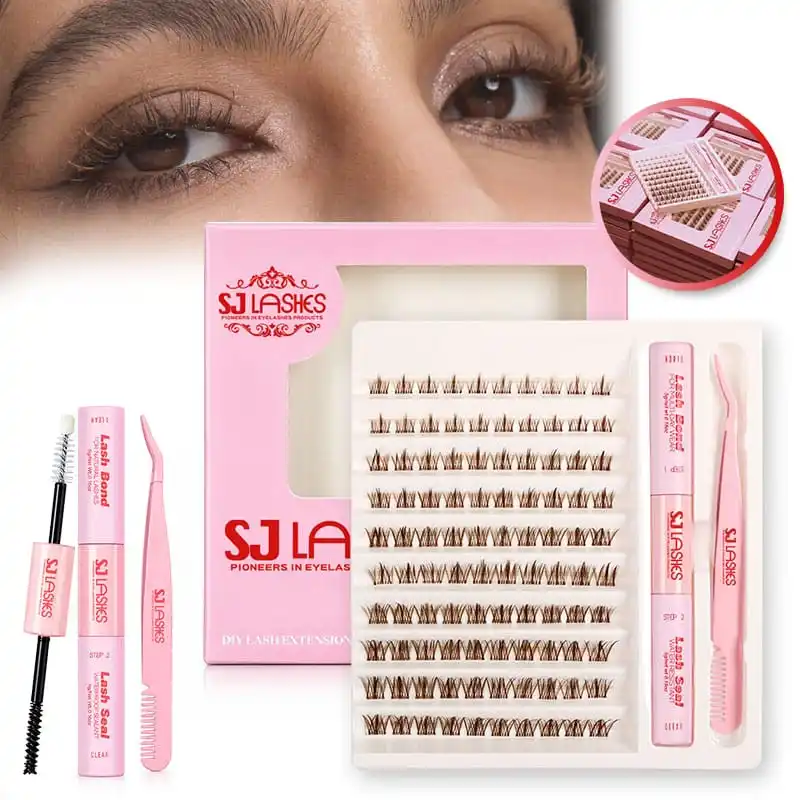
Most lash packaging holds one thing. This box holds four: ten rows of clusters, a bond, a seal and a dual-ended tool. And it has to show all four through a single window, in a box that survives a shipping carton, at a price that works for a mass-market kit.
That combination is what makes the all-in-one set box interesting. It is not a decoration problem — it is a tray problem. Everything else follows from how the tray is cut.
This is the box we built for a Mexico bulk programme, and the article covers it in order: the tray, the window, the tool, the two liquids, the back panel that carries the instructions, and then the two smaller formats the same programme ships — a hang-tab box and a gift box.
Four Components, One Window
Quick answer
| Question | Answer for this kit |
|---|---|
| What is it | An all-in-one DIY lash extension kit in a windowed paper box |
| What is inside | 10 rows of clusters, Lash Bond, Lash Seal, dual-ended tool |
| The structural core | One molded tray with three kinds of channel |
| The constraint | One window must reveal all four components |
| Why it sells | The customer sees a complete routine, not a component |
| Watch out for | Tubes escaping their channels in transit; a window cut before the tray is fixed |
One tray, three kinds of channel
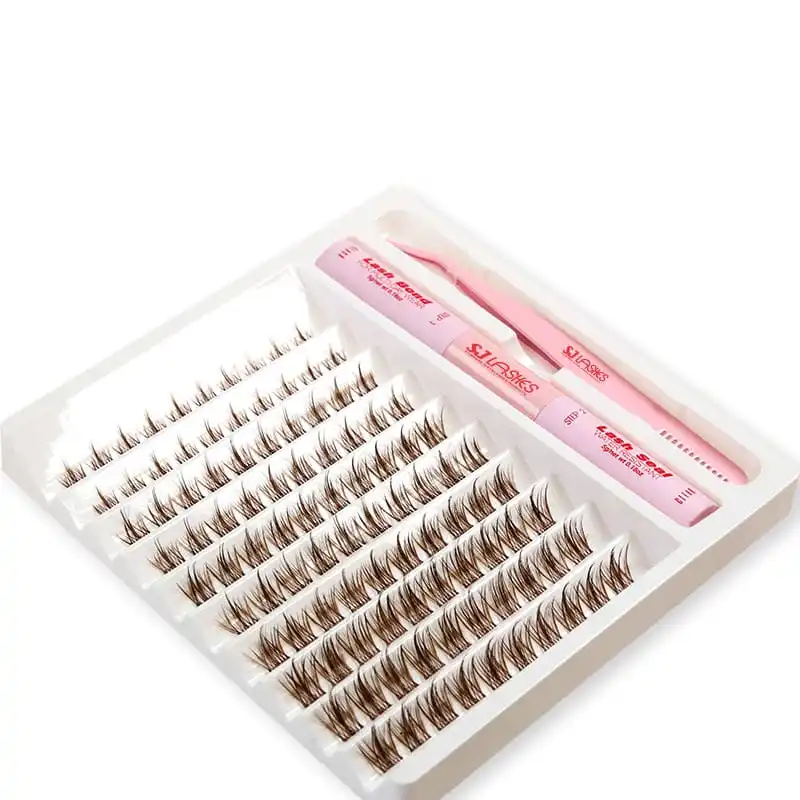
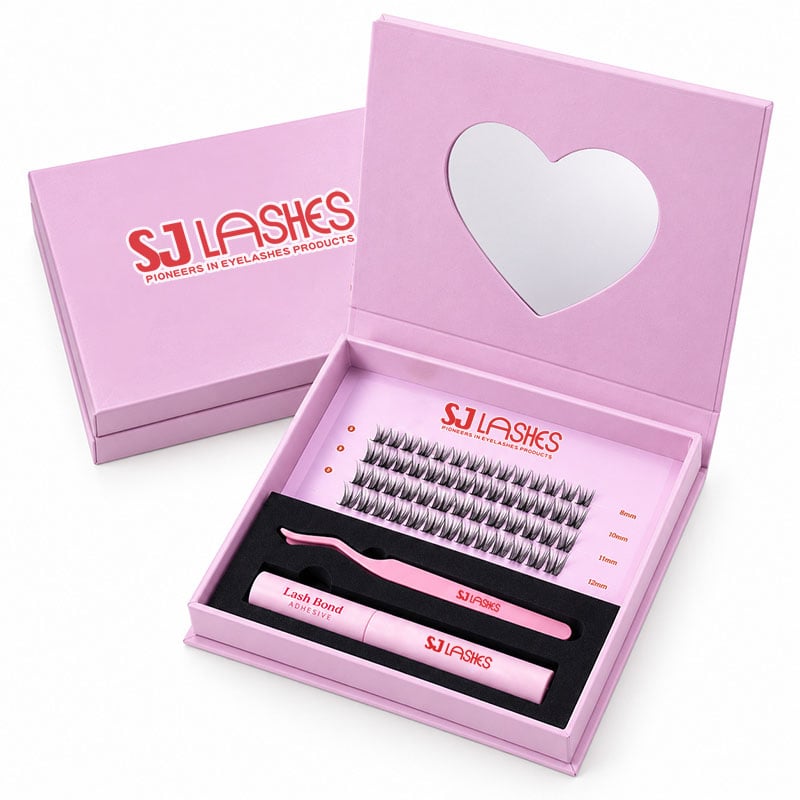
The whole kit rests on a single molded tray, and the design work is in the fact that it has to hold three different kinds of object at the same time.
A grid for clusters. Ten rows, each holding a run of clusters at a fixed spacing. The grid does two jobs: it protects the cluster shape, and it makes the count visible — the customer can see what she has.
Two channels for tubes. Lash Bond and Lash Seal sit side by side in elongated recesses at one end. This is the part that decides whether the kit survives shipping: a round tube in a flat recess will roll, and once it rolls it sits proud of the tray and stops the box closing properly. The channels here are cut to the tube's actual diameter with a retaining shape at each end, not a straight slot.
One channel for a long tool. The applicator is dual-ended, which makes it the longest single object in the kit, and its channel runs the full width of the tray.
One Tray, Three Kinds of Channel
The sequence matters. Decide the tray layout first, then the window, then the box. In that order the window is a view onto a layout that already works. In the reverse order — box, then window, then tray — the tray has to fit a window that was drawn before anyone knew where the tubes would sit, and the usual result is a window that hides the seal or crops the last two rows.
The window is cut to the tray
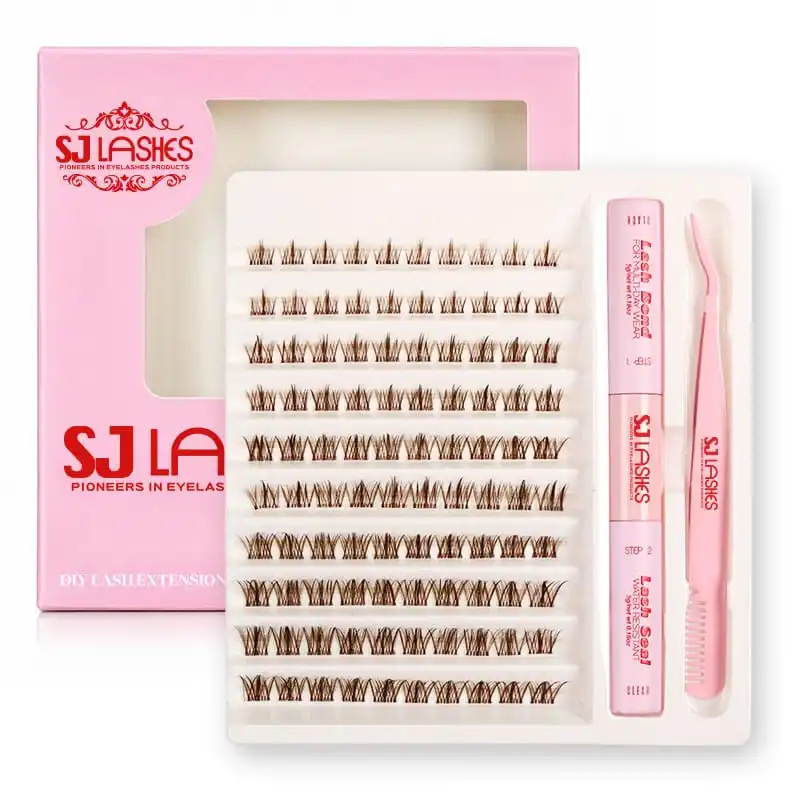
Look at the window on this box and you will notice it is not a rectangle. One side is arched, and the arch is not a decorative flourish — it is following the tray.
The reason is that a kit window does two jobs at once: it shows the product, and it tells the customer the kit is complete. A rectangular window sized to the lash grid will show the lashes beautifully and hide the seal tube, and a customer who cannot see the second liquid will assume it is not there. The arch here is what lets one opening cover the grid and the two tubes without the box becoming a display case with no branding space left.
A practical test. Fill the tray, close the box, and look at it the way a customer will: from the front, at arm's length, in normal shop light. If any of the four components is not identifiable, the window is wrong — not the tray.
The Arch Follows the Tray, Not the Other Way Round
The tool sets the width of everything
There is a chain of consequences in this kit that is easy to miss, and it starts with the applicator.
The tool is dual-ended, which makes it the longest object in the box. Its channel has to be longer than the tool, the channel runs across the tray, and the tray is therefore as wide as the tool plus the tray wall. The box is as wide as the tray, and the shipping carton is sized from the box.
So the tool's length decides the carton.
This matters because tool length is usually decided last. Someone chooses a dual-ended applicator because it gives the customer two functions for one component — a fair decision — and the box is already drawn. At that point the options are to shorten the tool, to angle the channel, or to accept a wider box, and all three are more expensive than deciding the order correctly at the start.
The practical rule: specify the tools before the structure. List every component with its longest dimension, and let the largest number set the tray. If you are choosing between a dual-ended tool and a single-ended one, know that the dual-ended version is not just an extra function — it is a wider box, a bigger carton and a different pallet count.
Two liquids, and why they must look different
The kit carries two liquids that are used in sequence and must not be confused: Lash Bond, applied first, and Lash Seal, applied after the clusters are placed.
At 5g each, in the same pink tube, at the same diameter, they are the hardest pair in the pack to tell apart. So the identification has to come from the design, and three things carry it:
- Step numbering on the tube. One is step 1, the other is step 2. This is the single most useful mark on either tube, because it survives being read at a glance and in a hurry.
- A visible difference in what is inside. One is clear, the other is not, and the tube is transparent enough for that to read.
- A difference in application head. One is a micro-brush for laying a line at the root, the other is a wand. The heads are not interchangeable, so the shape tells the customer which one she is holding.
If a supplier offers to make both tubes identical for a lower cost, decline. The customer who seals before bonding does not blame herself — she blames the kit.
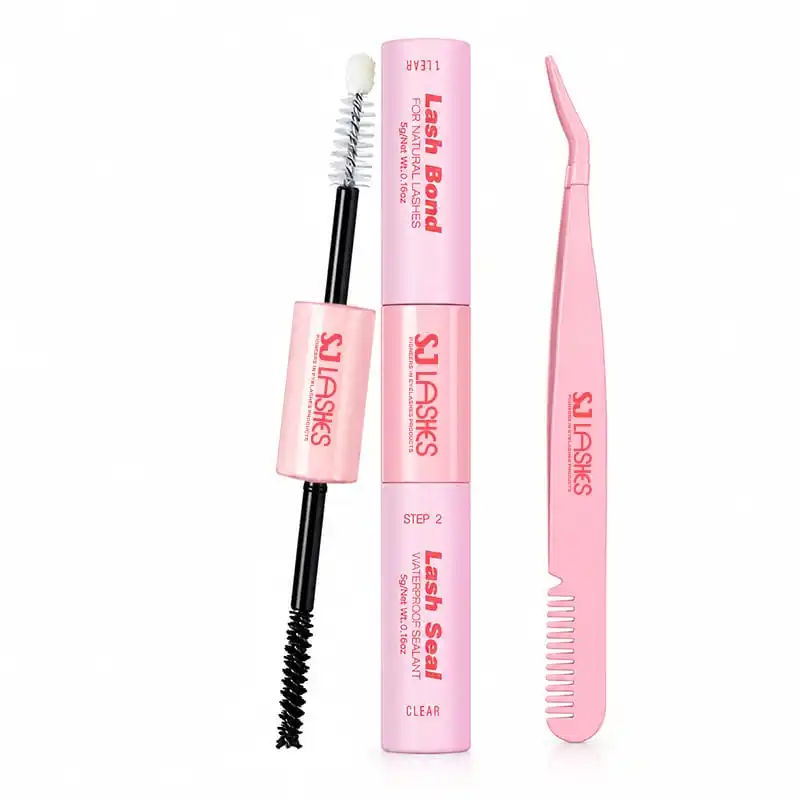
Step 1 and Step 2 — Different by Design, Not by Label Alone
The back panel is the instructions — and in Mexico, it has to be Spanish
Turn this box over and the back is a set of numbered instructions, each with an icon: clean the lashes, apply the bond below the root, place the clusters, adjust, seal, press to join.
That is a lot of content on a box back, and it is there for a reason: a kit sold as a complete routine has to teach the routine, and the cheapest place to put six steps is the panel you are already printing.
The language is the part that matters commercially. For Mexico, labelling of prepackaged cosmetics is governed by NOM-141-SSA1/SCFI-2012, under which the required information must appear in Spanish — other languages may be included, but only if the Spanish text is clear and predominant. A box whose instructions are only in English is not a box you can sell there. Confirm the current requirements with your regulatory partner before final artwork, because labelling rules and enforcement practice change.
So the Spanish back panel is not a nicety for this market. It is the difference between a sellable kit and a kit that has to be repacked.
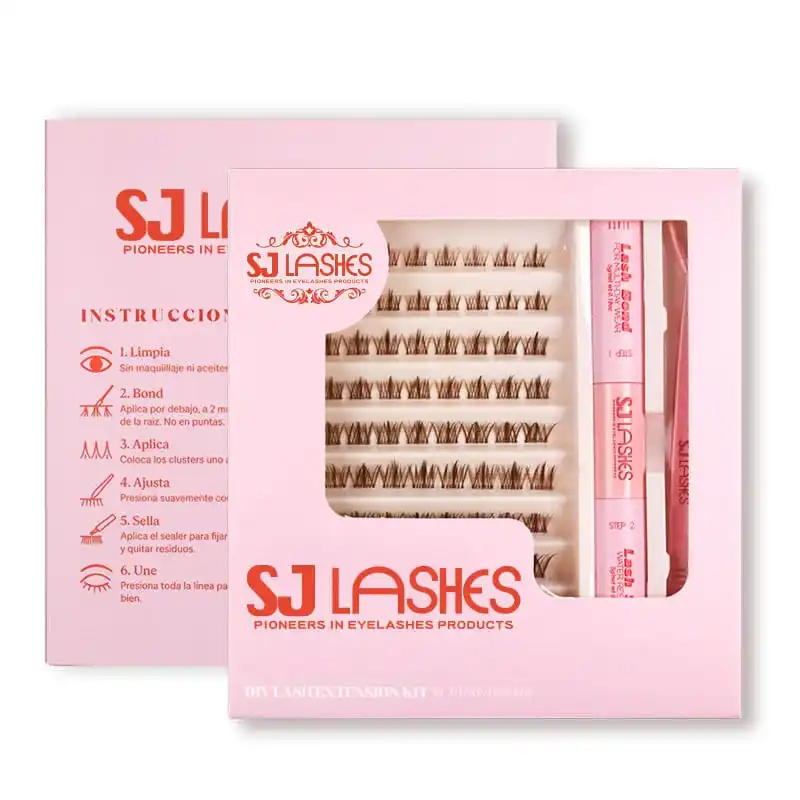
Six Steps, in the Customer's Language
There is a trade-off here worth stating plainly, because it is the opposite of the choice we describe elsewhere. Printing the instructions on the box back is cheaper per unit than printing a separate card, and it means the instructions cannot be lost. But it also means the box is now language-specific: one box per language, with its own artwork and its own print run. A brand selling the same kit into Mexico, Spain and the United States is running three boxes.
The alternative — a card — lets you keep one box across markets and change the card. Neither answer is right in the abstract. If you sell predominantly into one market, print on the box and take the saving. If you are spreading across markets, put the language on a card and keep the structure universal. The mistake is deciding this after the artwork is approved.
What the grid is actually protecting
It is worth being precise about why the tray grid is spaced the way it is, because "it looks tidy" is not the reason.
A cluster is a fan of fibres that meets at a small flat base. That base is what the bond grips, and the fan keeps its shape only as long as the fibres are not compressed against each other. Two things follow:
Spacing protects application, not appearance. Cluster fans touching each other in the tray will flatten where they meet, and a flattened base bonds less reliably than a clean one. The gap between rows is a functional dimension.
Depth protects the base. If the recess is shallow, the lid presses on the cluster tips and deforms the fan. If it is too deep, the cluster moves and the base scuffs. The right depth is the one where the closed box holds the cluster without gripping it.
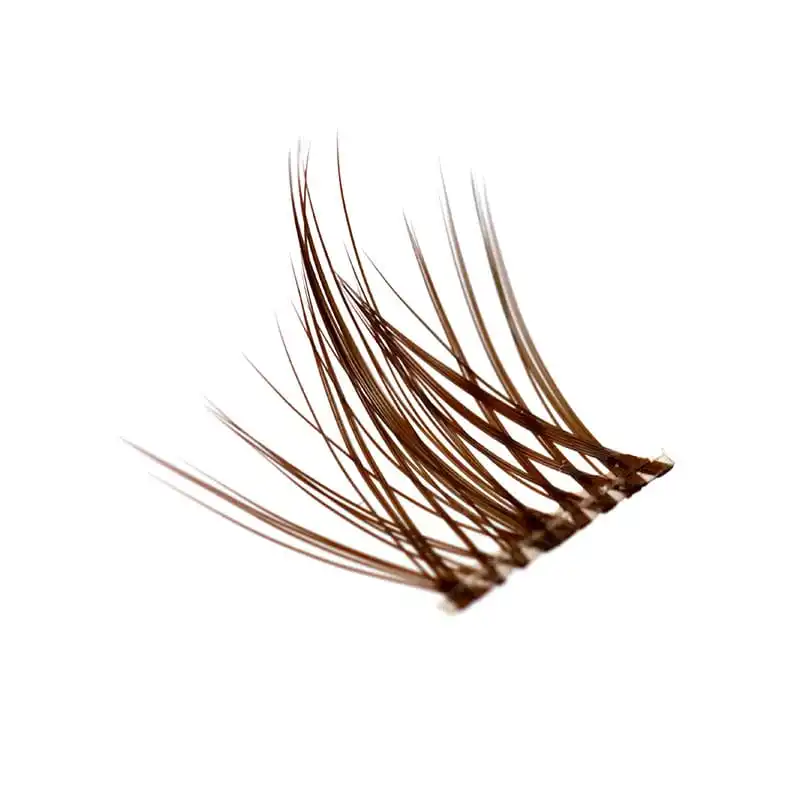
The Flat Base Is the Part That Has to Survive
The other two formats in the same programme
The set box is the hero of this range, but the same programme ships two smaller formats, and they are worth understanding because they answer different questions.
Selling a complete routine, stocking a hook, and giving a gift are three jobs, and one box cannot do all three well.
The hang-tab box: the reorder SKU
The first of the two is a slim pink box with a die-cut tab along the top edge — a slot shaped for a retail hook, which also works as a finger tab for carrying.
What it is for. It holds clusters only: 40 per pack, across four rows of mixed lengths. No bond, no seal, no tool. Which means it is not a starter product at all — it is the repeat purchase. The customer who bought the set box once already owns the liquids and the tool; what she runs out of is clusters. This box is the answer to that, and it should be merchandised and priced as a refill rather than as a cheaper version of the kit.
Getting that positioning wrong is a common and expensive mistake: a brand puts the refill on the shelf next to the kit at a similar price, the customer cannot tell why there are two, and both slow down.
The two design decisions. First, the tab and the window compete for the same top strip of the front panel — the tab needs clearance to be hung and to hang straight, and every millimetre it takes is a millimetre the window cannot use. Second, the tab has to be reinforced or it tears at the slot under the weight of a full box on a hook; a plain die-cut in 300gsm board will start to fail in a busy shop.
The arithmetic is a claim. This box states 40 clusters and 4 to 8 fresh sets, which is between five and ten clusters per set. That is a computable promise, and a customer who counts will check it. Make sure the count and the claim hold on the actual packed weight, not just on the artwork.
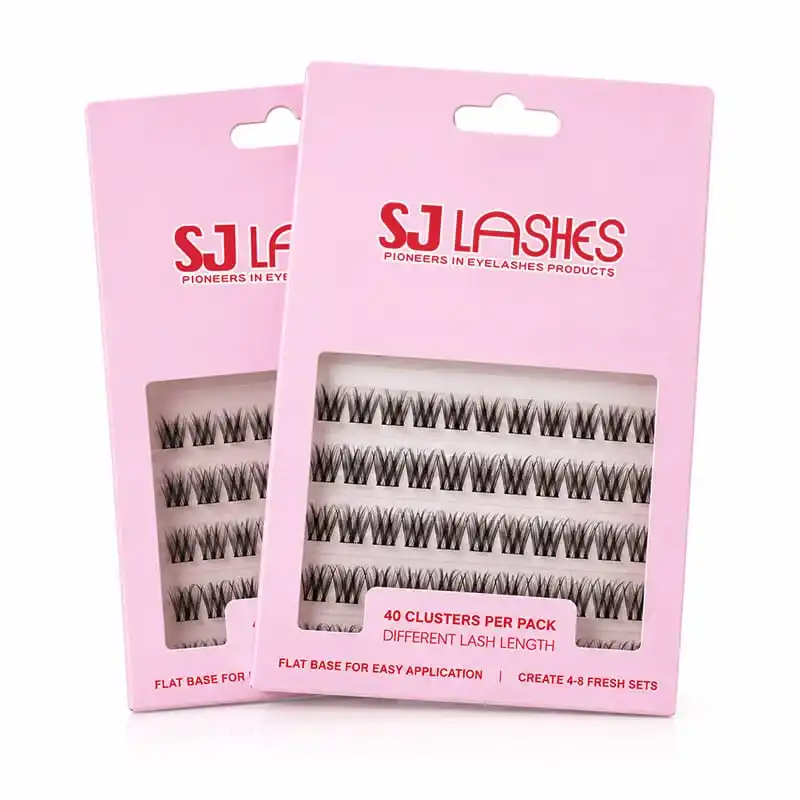
The Tab Is What Makes It a Hook Product
The gift box: the inside is the product
The second format is a flip-top gift box in the same pink, with a hinged lid and no window at all. Open it and the interior is a printed panel carrying five rows of clusters, with each row's length printed at its open end — 10 mm, 11 mm, 12 mm and 14 mm visible in the photograph.
Two things make this format work, and both are about the absence of a window.
The reveal replaces the window. With nothing to see from outside, the box is sold on its finish and on what happens when it opens. That means the interior cannot be left as raw board: the panel is printed, the brand sits inside, and the rows are laid out to be read. The inside is not packaging around the product — on a gift box, the inside is the product experience.
The length labels do the explaining. Five rows of clusters look like five rows of clusters. Five rows labelled 10, 11, 12 and 14 mm look like a mapped set — a graduation someone chose. That single printed label changes what the customer thinks she is holding, and it costs nothing but a line of type. If you print one thing inside a gift box, print the lengths.
Inside a Gift Box, the Panel Is the Design
One tray, not four
There is a manufacturing reason this kit uses a single molded tray rather than separate holders, and it shows up in your unit cost before it shows up in the box.
Four components could be held four ways: a lash blister, two tube clips and a tool clip. That is four parts to source, four parts to stock, four parts to place, and four chances that one of them is out of alignment on a Monday morning. One tray is one part: one mould, one stock line, one placement, and a single alignment that either works or does not.
It also ships better. The trays nest and the closed boxes stack flat, which is why a bulk order of this set looks like the photograph below rather than a pile of loose shells.
The trade-off to be aware of: a single tray means a single tooling investment, and a change to any one component — a wider tube, a longer tool — changes the whole tray. If you expect the kit's contents to change often, ask what a tray revision costs before you commit, because that number is the real cost of flexibility in this format.
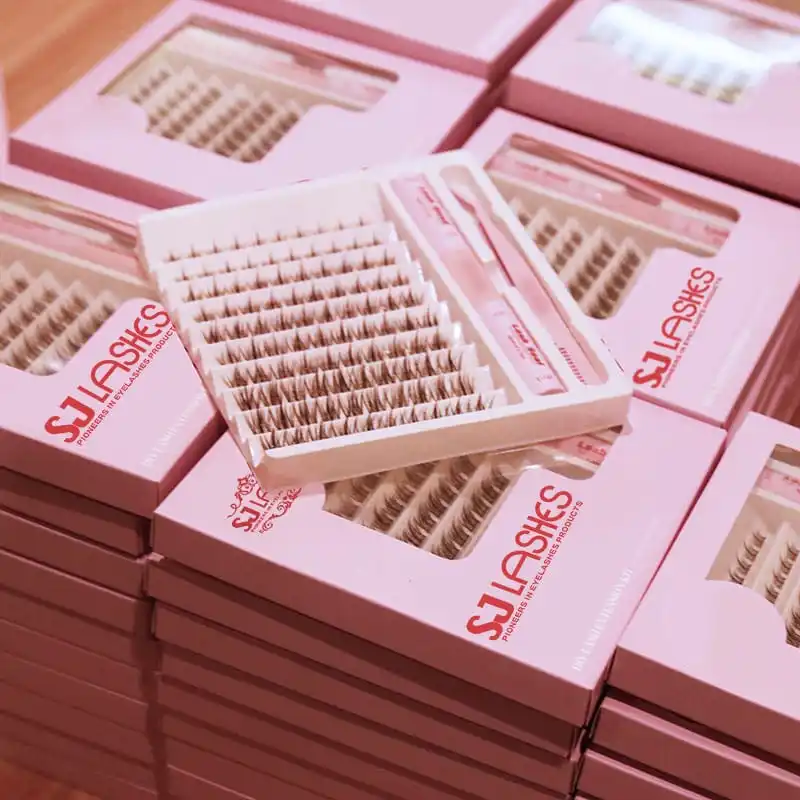
One Part to Stock, One Alignment to Get Right
Choosing between the three
- Selling a complete routine to someone who has never done it → the set box. It is the only one of the three that teaches the routine and supplies every component.
- Selling clusters to a customer who already has the kit → the hang-tab box. It is a refill, and it should be labelled as one.
- Selling the product as a present, or as the top of the range → the gift box. No window, printed interior, graduated rows.
They are not three price points on the same product. They are three different jobs, and a brand that treats them as a ladder will usually end up discounting one against the others.
Supplier scorecard and sampling
What to ask
- What holds each tube in place, and what happens to that retention after fifty open-and-close cycles?
- How is the window aligned to the tray — is it cut from the tray drawing or drawn independently?
- What is the tray's revision cost if a component changes size?
- Are the two liquids distinguishable at a glance without reading the label?
- If the instructions are printed on the box back, what does a second language cost in artwork and minimum order?
- For the hang-tab version, is the tab reinforced, and what weight is it rated to hang?
- For the gift box, can the inner panel carry print and row length labels?
What to check on a sample
- Shake test. Fill the tray, close the box, shake it. No tube should move out of its channel.
- Window test. Fill it, close it, stand back at arm's length. All four components should be identifiable.
- Tube test. Hand both tubes to someone who has never used the kit and ask which goes first. If she hesitates, the design has not done its job.
- Repeat test. Open and close fifty times. The tubes should still seat and the box should still close flat.
- Hang test. For the hang-tab box, hang a fully loaded box and leave it. Check the slot after a week, not after a minute.
- Count test. Count the clusters in a packed unit. Verify the stated count and the "fresh sets" claim against what is actually inside.
Quote checklist
- Target market and language — and whether instructions go on the box back or a card.
- Box format: set box, hang-tab box, or gift box.
- Box size, board grade and window shape.
- Tray material and colour, with channel dimensions for each component.
- Cluster count, rows and length range.
- Tube specification — capacity, diameter and application head, for each liquid.
- Tool specification and overall length.
- Print specification for the front, the back panel and, on the gift box, the inner panel.
- Cluster and row-length labelling.
- Carton and pallet configuration.
- Sampling quantity and lead time.
👉Request samples of our lash kit boxes
Compliance and honest claims
- Spanish is not optional in Mexico. Under NOM-141-SSA1/SCFI-2012 the required information must appear in Spanish, and other languages may be included only where the Spanish is clear and predominant. Check the current text with your regulatory partner before approving artwork.
- A 5g tube has almost nowhere to print. Required information — product name, ingredients, net content, the responsible party — has to live somewhere, and on a tube this small that somewhere is usually the box or an insert. Which means the box back is doing compliance work, not just instructions. Plan the space for it rather than discovering the shortfall at artwork stage.
- Instructions are not a substitute for labelling. Six well-written steps do not satisfy a labelling requirement. They sit alongside it.
- Substantiate the waterproof claim. The seal is described as a waterproof sealant. That is a performance claim, and it should be supported by testing rather than assumed from the formulation.
- Check the counts. "40 clusters per pack" and "4 to 8 fresh sets" are computable promises. Verify them against packed units.
- Mind the tool tip. A metal-tipped applicator in a tray can pierce the tray wall or a tube if the pack is dropped. Check that the tool channel captures both ends, and test a drop rather than a shake.
Why SJ LASHES
An all-in-one kit is an assembly problem with a branding problem on top, and both have to be solved before the first cut.
- We specify the tray, the components and the window as one job. The window is cut from the tray layout, so what the customer sees is what the tray actually holds.
- We build the liquid and the tool to the box, not after it. Tube diameter and tool length set the tray; we settle those numbers before artwork, because changing them afterwards changes the mould.
- We handle market language as a design decision. Box back or card, one market or several — that choice drives the artwork and the minimum order, so it belongs in the brief.
- We assemble and pack the kit, not just print the box. Trays, tubes, tools and printed panels arrive as one finished unit.
- Low minimums and fast sampling. The things that go wrong in this format — a tube that rolls, a window that hides the seal, a tab that tears — are all visible in a physical sample. We would rather find them there.
👉Talk to us about your lash kit box · See packaging options
Frequently asked questions
What goes inside an all-in-one DIY lash extension kit? In this kit: ten rows of clusters, a Lash Bond, a Lash Seal and a dual-ended applicator, all held in a single molded tray behind one window.
Why is the window on this box arched rather than rectangular? Because it is cut to follow the tray. A rectangle sized to the lash grid would hide one of the two tubes, and a customer who cannot see the seal will assume it is missing.
Should the instructions be printed on the box or on a card? It depends on how many markets you sell into. On the box is cheaper per unit and cannot be lost, but it locks the box to one language. On a card, one box serves several markets and only the card changes. Decide this before the artwork is approved.
Is Spanish required on the packaging for Mexico? For prepackaged cosmetics, labelling requirements include Spanish, with other languages permitted only where the Spanish is clear and predominant. Confirm the current requirements with your regulatory partner.
What is the difference between the hang-tab box and the gift box? The hang-tab box is a cluster refill for a customer who already owns the kit, designed for a retail hook. The gift box is a presentation format with no window, a printed interior and graduated rows labelled by length.
How many sets can a customer get from a 40-cluster pack? The pack states four to eight fresh sets, which works out at five to ten clusters per set. Verify the count against packed units before you print it.
Can the tool be shorter to make the box smaller? Yes, and it is worth asking early. The tool is the longest component, so its length sets the tray width, the box width and the carton size. Changing it after the mould exists is much more expensive than choosing it first.
What should we test first on a kit sample? Shake it, then open and close it fifty times, then hand the two tubes to someone who has never used the kit and see whether she can tell which goes first.
The takeaway
An all-in-one kit looks like a branding exercise and behaves like an assembly. The tray decides what fits, the longest component decides how wide everything is, the window decides what the customer believes is in the box, and the back panel decides which markets you can sell into.
Get those four in that order and the box sells a routine. Get them in any other order and you will be re-cutting a mould to fix a window.
Related reading: the three most popular lash box types · our guide to the bifold lash gift box