EN

Complete Lash Set Packaging: Three Clocks, One Set (2026)
The question a set answers
Nobody buys a set because it is four things. They buy it because of the question it answers: can I do this without having to buy anything else?
That question changes the packaging brief completely. A single SKU can be optimised on its own terms — the card on how it releases, the carton on how it labels. A set has to be optimised on what happens when the four parts meet: on a shelf, in a mailer, in a warehouse, and in the customer's bathroom six months later.
This set is a glue-free segment lash programme: segment lashes on a printed card inside a clear case, a pair of pink tweezers, and a 5g lash adhesive in a slim folding carton.
Four components. Owned by three different production processes. And — this is the part that decides whether the set ships cleanly — running on three different clocks.
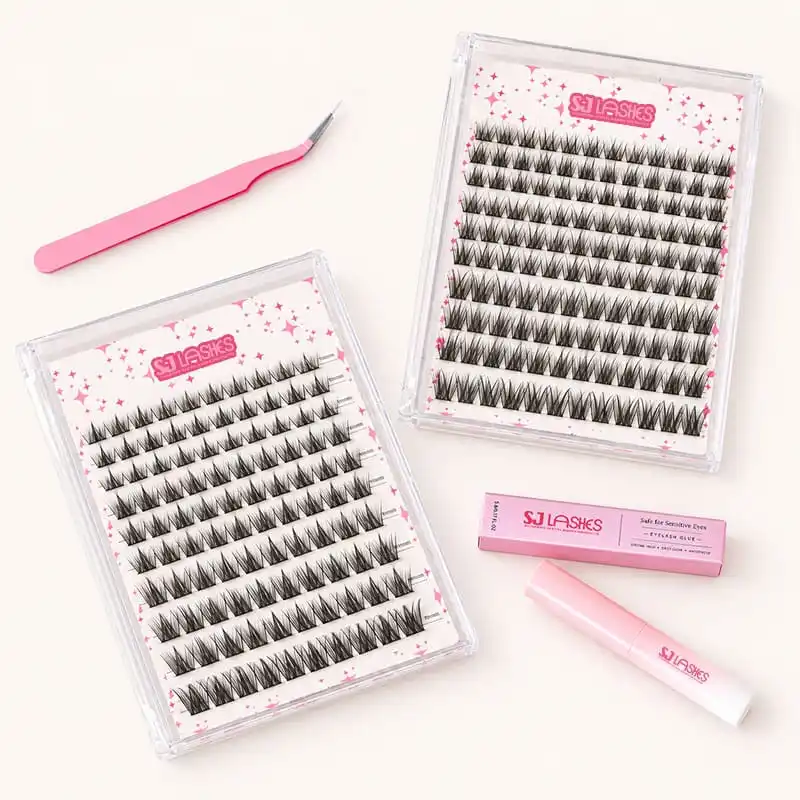
Four Components, Sold as One Answer
Quick answer
| Question | Answer for this set |
|---|---|
| What is in it | Segment lash card + clear case, tweezers, 5g lash adhesive + carton |
| What the customer is buying | A complete routine, not four products |
| The three clocks | Colour across four substrates, expiry on the glue only, three separate minimums |
| Shortest clock wins | The set's shelf life is the glue's shelf life, not the card's |
| Hardest part to control | Matching one pink across paper, board, plastic and a gradient bottle |
| Most common mistake | Printing cards in one big run, then filling glue later against dates |
| Where to put instructions | One surface, one version — the card is where the eye already is |
Clock one: one pink, four substrates
Look at the set and everything is pink. Look closely and it is four different pinks — and that is normal, not a supplier error.
The card is printed on coated paper: ink sits on a sealed surface and reads bright and flat. The carton is board, often matte, with a different ink absorption and a different surface sheen. The tweezers are plastic, coloured in the mould or painted, and plastic never matches paper exactly. The bottle is a gradient — pink at the cap fading to white at the base — so it has no single value to match at all.
Four substrates means four ways for the same reference colour to drift. What decides whether the set looks intentional is not getting them identical — it is deciding which one is the reference, and how much drift you will accept.
Three practical ways to control it:
- Nominate a reference and a tolerance. Pick the carton or the card as the master — whichever the customer sees first at the size that matters — and accept that the others will sit slightly either side of it. Ask for the tolerance in writing.
- Choose a colour that tolerates drift. Mid-tone pinks, nudes and muted colours hide small differences; saturated magentas and pastel tints show every one of them. The pink in this set is forgiving on purpose.
- Use the gradient as cover. A bottle that fades to white has no value to match at its base, so the eye does not compare it edge to edge with a flat card. That is a design decision disguised as a finish.
What to check, and where: under the light the product will actually be sold in. A set that matches in a photo studio and separates under warm retail lighting was never matched — it was lit.
Clock two: only one component expires
Here is the asymmetry that decides your production plan, and it comes straight out of how the two packs are built.
The card carries no dates. It is a printed carrier; nothing on it expires. It can be printed in one large run and stored.
The carton carries the dates. On the bulk cartons in these photographs the back panel shows production 20/08/2024 and expiry 20/08/2028, printed on the panel beside the warning block.
So the set has exactly one perishable document inside it — and the set's shelf life is the glue's shelf life, no matter how long the cards can sit.
Three consequences follow, and they are the ones that catch people out.
Kitting has to happen in date order. If cards were printed last year and glue is filled this year, you are fine — but the reverse, new cards kitted with older glue, silently shortens the set's life. Kit oldest glue first, always.
The card must not claim a date. A card that prints its own "made in" date creates a second clock that will contradict the carton.
A rebrand splits the set. Change the card artwork and the old cards stay valid while the new cartons arrive with new dates — so for a period your set is half old brand, half new. That is the single strongest argument for printing the carton generically and overprinting the dates at filling.
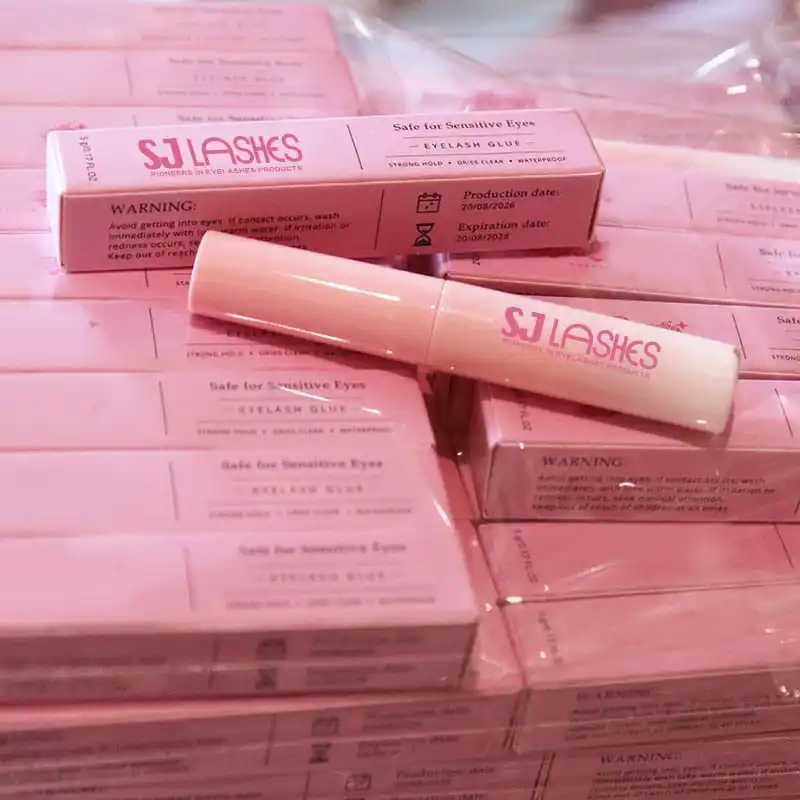
The Only Part of the Set That Expires
Clock three: three minimums and one kitting line
A set is four components, and each one has its own minimum. Which produces a rule that surprises almost every first-time buyer:
The set's minimum is not an average of the components' minimums. It is the highest one.
If cards start at one quantity, cartons at another, and tweezers at a third, you cannot assemble fewer sets than the largest minimum allows — and the leftovers of the other three become stock you paid for and cannot sell. Ask each component for its minimum before you price the set, and design the set around the highest number rather than discovering it at order.
Then there is kitting. Someone has to put four items into one presentation, and that labour has four failure modes that no specification catches:
- The mismatch set. A card with a scuff, a carton with a crushed corner, a tweezer with a moulding mark — each was acceptable on its own, and together they look like seconds. Sets are judged by their worst component.
- The missing part. A set short of its tweezers is not a set; it is a complaint, and it will be discovered by the customer rather than the packer.
- The double count. The opposite error, which costs you margin quietly.
- The drift. Kitting rules that live in someone's head and not on a sheet will be applied differently on a Friday afternoon.
The fix is boring and it works: a kitting sheet with a photograph of a correct set, a fixed packing order, and a count check at the end of every carton. Ask your supplier for it, and ask to see it before the first production run.
What custom covers — and where it stops
Four components means four different kinds of change, and buyers usually brief them as if they were one.
The card changes by print: size (8×10cm, 9×12cm and 10×14cm are existing dies here), card colour, logo treatment — flat print, gold foil, or a specified colour — and the layout of the rows.
The carton changes by print and by board: colour, logo, dimensions, structure.
The tweezers change by colour only. There is no print on a moulded tool; the colour is in the material or on it, and it is the component least able to match the others.
The bottle changes by colour and by gradient. A gradient is a decoration of the bottle, not a print, and it is the reason the set has no single reference value to match.
What a colour choice cannot change: the net content, the warning text, the dates, and the claims. Those follow what is inside and where it is sold.
The practical rule that prevents most of the confusion: one artwork file per component, one nominated reference colour for all four. Briefing them separately is how a set ends up with four pinks that were each approved.
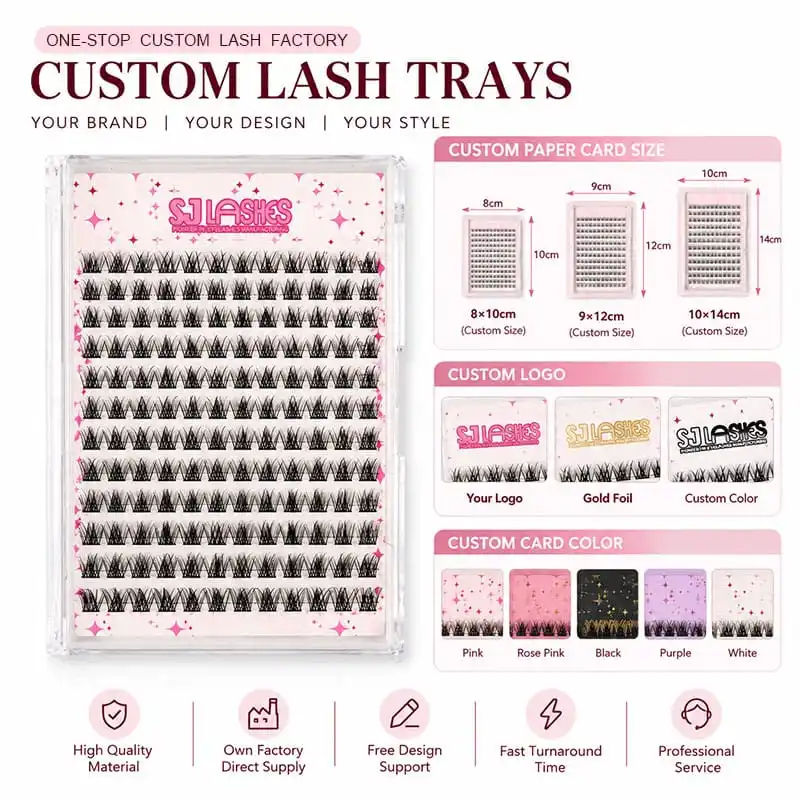
The Card Customises by Print
The adhesive carton offers the same kind of menu on a smaller canvas — five stock box colours, any specified colour, and the logo in any colourway. Note what stays fixed while the colour changes: the net content declaration and the claims on the front panel are the product's, not the brand's, and they follow the fill into every market you sell in.
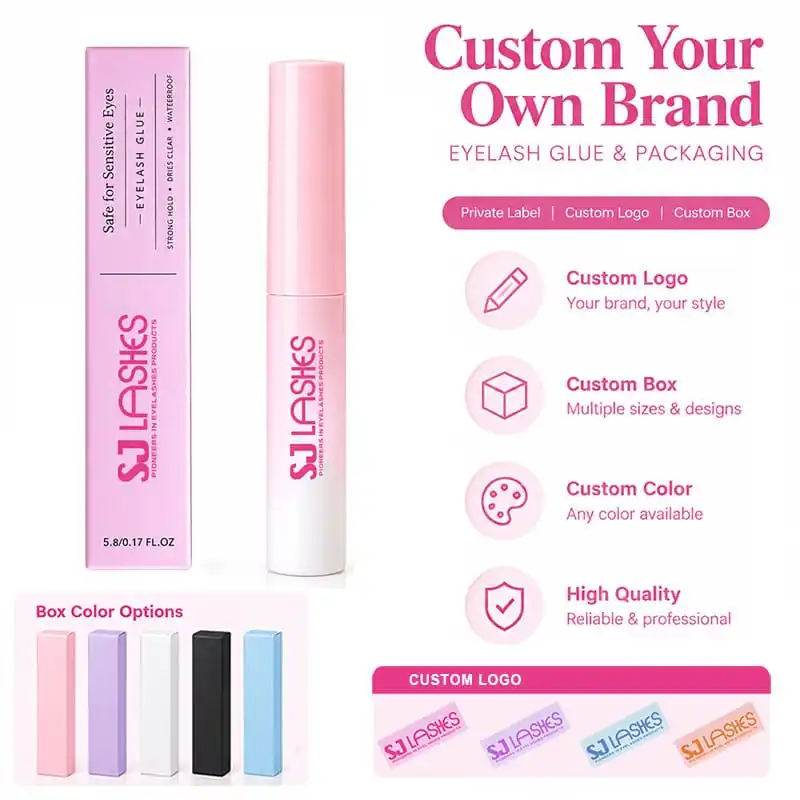
The Carton Customises by Print Too — Except the Label
What each component is actually doing
It is worth being precise, because the set only feels complete if each part is doing a distinct job rather than duplicating another.
The card: hold and release. The segments sit on a printed card, held along their base. The card's whole engineering brief is adhesion versus clean release — and the printed length labels down the rows are what let a customer work without instructions.
The case: be the structure. The card has no depth, so the clear case supplies rigidity, a gap above the fibres so fans are not crushed, and a hinge that survives being opened repeatedly.
The tweezers: be the interface. A segment lash cannot be placed with fingers. The tool is not an accessory; without it the set is unopenable.
The carton: be the label. A 5g bottle has nowhere to print, so the carton carries net content, warnings and dates. The bottle carries the brand; the carton carries the law.
The test for any set: remove one component and see whether the customer can still complete the routine. If removing it still works, it is not part of the set — it is a gift with purchase, and it should be priced and designed that way.
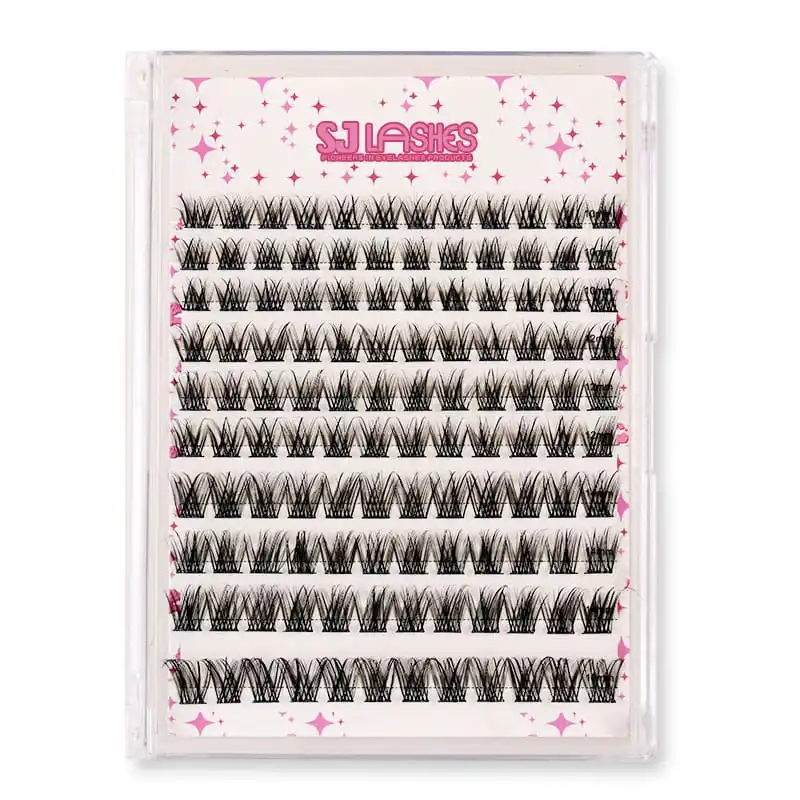
The Card Holds, the Case Protects
One instruction surface, not three
A set with four printed components has four places to say something — and that is a risk, not a feature.
The rule that keeps it coherent: each surface says one kind of thing, and never repeats another surface in slightly different words.
- The card speaks to the person doing her lashes: lengths down the rows, brand at the top. This is where the eye already is when the case opens, so this is where the sequence belongs — short and in order.
- The carton speaks to the person deciding whether to buy, and to whoever audits the pack: claims on the front, warnings and dates on the back.
- The case and the bag say nothing at all, beyond what a customer needs to know to open them. Silence is cheaper and looks more expensive.
Why this matters more than it sounds: two instruction surfaces drift apart. One says apply underneath the natural lash, the other says 1–2mm above the lash line; both were written by different people at different times; the customer reads both and trusts neither. In a set, that contradiction is not a copy problem — it is the set contradicting itself about how to use it.
Before you print, put every instruction from every component on one page and check that they agree.
The contradiction a set can create
There is one more thing this particular set has to solve, and it is worth stating plainly because a customer will notice it in the first five seconds.
The lashes are sold as glue-free. The set contains a bottle of glue.
Unless the pack explains the relationship, the two facts cancel each other and the customer concludes that one of them is marketing. There are honest ways to resolve it — the segments may be self-adhesive at the base while the adhesive serves a different product, or the adhesive may be for a lash type not in this set — but the resolution has to be said, on the pack, in one sentence a customer can repeat.
Two things to get right:
- Say what the adhesive is for, explicitly. "Segments apply without adhesive; the glue is included for the strip lashes" is a sentence that ends the confusion. Leaving it out does not.
- Do not write "no adhesive." Glue-free describes the application, not the chemistry. Something in that box is sticky, and a customer will find it and be annoyed. Say glue-free application.
This is the kind of thing that never shows up in a design review and always shows up in reviews.
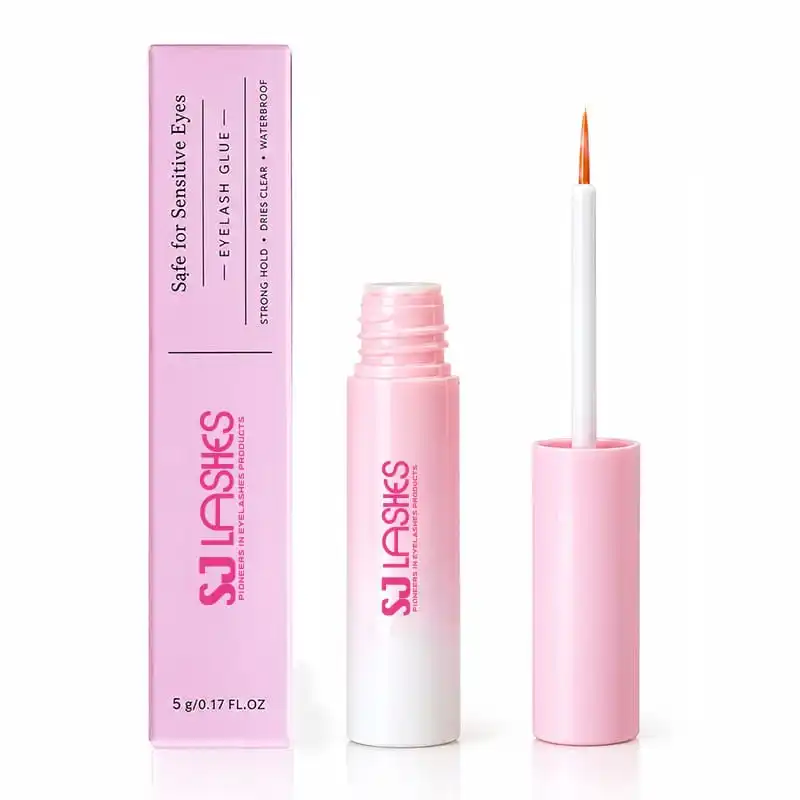
The Bottle That Has to Explain Itself
Three ways to present the set
The components exist; the presentation is a separate decision, and it changes cost, protection and unboxing.
Bagged. Card in case, tweezers and carton dropped into a clear or printed bag. Cheapest, fastest to kit, lightest to ship — and the least protective. Fine for marketplace and wholesale cartons; weak as a gift.
Trayed in a box. A moulded or folded tray holds the case, the tool and the carton, inside a printed box. The best unboxing and the best protection, and the most tooling — it needs a die, and the tray has to be re-cut if any component changes size.
Band or sleeve around the components. No outer box; a printed band or sleeve holds the case and the carton together as a unit. Cheap, distinctive, and honest about being a bundle — but it exposes the components to handling, so it only works when the case and carton are robust enough to be the front of the pack.
Choose by how it will be judged. On a shelf, presentation does the selling. In a mailer, protection does. As a gift, the opening sequence does. One set, three answers — and none of them is "whatever we already have."
Supplier scorecard
What to ask
- What is the minimum for each component, separately?
- Which pink is the reference, and what tolerance do you hold across paper, board and plastic?
- How are dates applied to the carton — printed in artwork or overprinted?
- If overprinted, what area is reserved and how large is the stamp?
- How is the set kitted, in what order, and where is the count check?
- Do you kit oldest glue first, and can you show the date log?
- What is the packing configuration for the assembled set?
- Which component drives the set's lead time?
What to test on a sample set
- Colour under real light. Put the four components side by side under warm retail lighting, not studio light, and look for the one that separates.
- The full routine. Open it, apply a segment, use the tool, seal it. If a step needs something not in the box, the set is incomplete.
- Instruction audit. Read every printed word on every component. Flag any two that disagree.
- Drop test as a set, not per component. The set fails at its weakest interface — usually the carton or the case corner.
- Count and identify. Confirm the kitting sheet matches a real set, and that a correct set can be verified by someone who did not pack it.
- Date check. Confirm the carton's dates are the current batch and not a previous run.
Quote checklist
- Component list, with the exact board, plastic and bottle specification for each.
- Minimum per component, and which one sets the set's minimum.
- Reference colour and the tolerance you will accept, in writing.
- Card size, colour, logo treatment and whether foil is used.
- Carton dimensions, board, colours, and whether white ink is needed on a dark box.
- Date method on the carton, with reserved area if overprinted.
- Kitting: order, count check, and who supplies the packing sheet.
- Presentation format: bag, tray and box, or band and sleeve.
- Packing configuration and carton marks.
- Sampling: one assembled set, not four separate samples.
- Lead time by component, and the critical path.
Compliance and honest claims
- Only one component carries the label, so it has to carry all of it. Net content, warnings, dates, responsible party and ingredient information live on the glue carton — or on an insert. Confirm the requirements for each market with your regulatory partner.
- The set's expiry is the glue's expiry. Whatever the outer pack says, the customer will read the carton. Do not print a longer shelf life anywhere on the set than the shortest-dated component supports.
- "Glue-free" needs a sentence of explanation inside a set that contains glue. Resolve it on the pack, not in customer service.
- Do not claim "no adhesive." Glue-free describes the application method; the product still adheres.
- Claims on the carton front are inherited by every market. Strong hold, dries clear, waterproof and sensitive-eye wording are performance claims — keep the test basis on file.
- Keep the colour promise vague in copy. "Signature pink" survives a batch; "exact Pantone match across all components" is a promise four substrates will not keep.
Why SJ LASHES
A set is not four products with one invoice. It is four production processes that have to agree on a colour, a date and a minimum — and the agreement is the hard part.
- We quote all four components together, so you see where the minimum actually lands before you commit.
- We nominate a reference colour and hold a written tolerance across card, carton and plastic, instead of promising an exact match nobody can keep.
- We plan the date method with you, because printed dates and overprinted dates lead to different minimums and a different filling line.
- We kit against a sheet with a photograph and a count check, so a missing tweezer is caught in the factory and not by the customer.
- We audit instructions across every component before print, because a set that contradicts itself is worse than a set that says less.
- Low minimums, fast sampling, one assembled sample set — so you approve the thing the customer receives, not four things that might combine.
👉Talk to us about your lash set · See packaging options
Frequently asked questions
What should a complete DIY lash set contain? Enough to finish the routine without buying anything else: the segment lashes, a tool to place them, and whatever bonds and seals them. A set missing any one of those is not complete, whatever the box says.
Why is the set's minimum the highest component minimum? Because you cannot assemble more sets than the scarcest component allows. The other components' minimums become stock you have paid for and cannot sell.
Can I print the cards in one big run and fill glue later? Yes — the card carries no dates, so it stores. The constraint is the other way round: kit the oldest glue first, or the set's shelf life quietly shrinks.
Why don't the four pinks match exactly? They are printed on coated paper, printed on board, moulded in plastic and sprayed as a gradient. The honest approach is a nominated reference plus a tolerance, not an exact match.
Where should the instructions go? On one surface — usually the card, because that is where the eye is when the case opens. The carton carries compliance. Never split one instruction across two components in different words.
A set with glue-free lashes and a bottle of glue — isn't that contradictory? Only if the pack does not explain it. Say what the adhesive is for, in one plain sentence. Glue-free means the application needs no separate glue for those segments; it does not mean nothing in the box is sticky.
Bag, tray or band — which presentation is best? Bag if cost and weight matter; tray in a box if unboxing and protection matter; band or sleeve if you want a distinctive bundle and the components are robust enough to be the front of the pack.
The takeaway
A complete set is not four products in one carton. It is three clocks that have to agree before it ships: a colour across four substrates, an expiry that lives on one component only, and a minimum set by whichever part is scarcest.
Get those three aligned and the set does the thing sets are for — it answers "can I do this without buying anything else?" with a yes. Skip them, and the set will look right in a render and fall apart in a warehouse, a mailer, or a review.
👉Related reading: custom segment lash cards · lash glue boxes: the carton is the label