EN
EN
Kraft Eco Lash Box for Curved-Band Segment Lashes — The 2026 OEM Guide
At the end of our guide to the pink segmented lash box, we said the kraft eco box was in production and would get its own guide — specifications, tray engineering, finishing options, compliance notes and photographs.
This is that guide. And it arrives at a useful moment, because the compliance picture for eco packaging changed two days ago.
Here is the problem this box has to solve. "The material is the message" is a good design principle, and unbleached kraft carries it better than any coated white board. But an eco box is not just board. It is board, plus a window film, plus a tray or card, plus a lash product inside it — and those four things are not equally sustainable. A box that reads as fully biodegradable while containing a PVC window and a synthetic fibre tray is claiming for the whole what is true only of the part.
That distinction stopped being a matter of taste on 27 September 2026, when EU Directive 2024/825 began to apply. It prohibits presenting an environmental claim as applying to an entire product where it in fact relates only to a specific aspect of it.
So this guide covers two things at once: how the kraft eco segment box is engineered, and how to keep its environmental claim defensible once the window, the tray and the lash are counted.
👉Request a free sample and quote for your kraft eco lash box
Quick answer
A kraft eco lash box works commercially when four design decisions agree with each other:
- Unbleached kraft board as the primary material, with graphics printed into the board rather than applied over it.
- A material band on the front panel that names what the product is made of — cotton band, natural hemp fibres — so the claim is stated in materials rather than implied by a colour.
- A window that shows the lash rows without a plastic lid, so visibility does not require adding plastic.
- A millimetre ladder printed down the card from 10mm to 18mm, which makes a five-row set countable and reorderable at a glance.
And one compliance rule that sits over all four: whatever you claim must be true of every component a customer has to discard — not just the box.
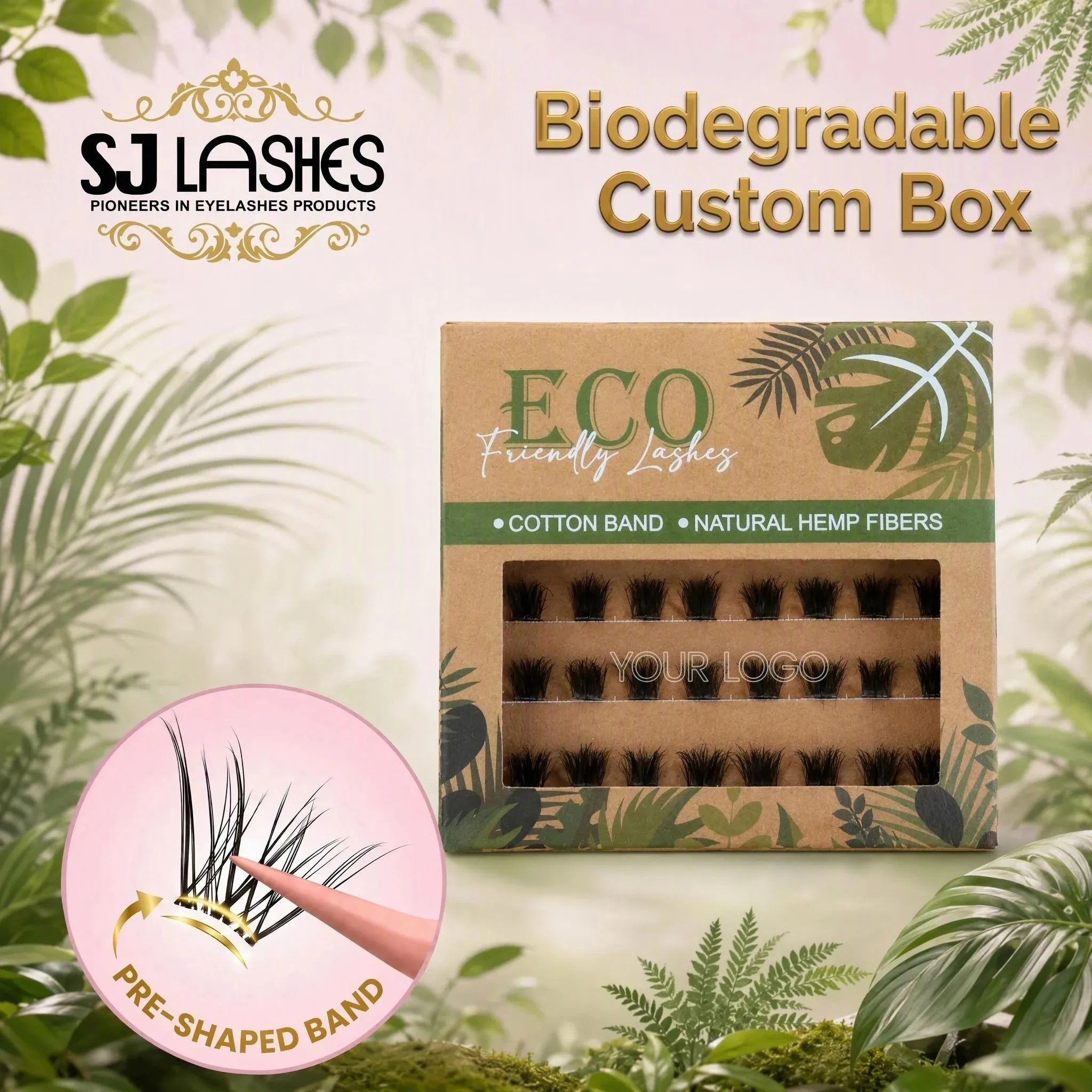
Image title: The Board Is the Message — Provided the Other Components Agree
What this box actually is
The board, and how the print sits on it
Unbleached kraft is the material and the aesthetic at the same time. The artwork is printed into the board rather than laid over it, which matters for two reasons: leaf motifs that sit flush with the kraft keep the natural surface reading as a surface, and printing without a heavy white flood coat leaves the board's own colour doing the work.
That decision also has a practical benefit. Because the kraft tone carries the palette, a change of tray frame colour does not force a change of board stock — you can re-colour the frame without re-specifying the box.
The material band
Across the upper front panel runs a two-line band naming what the product is made of: cotton band, natural hemp fibres.
This is the most useful element on the box, and it is worth being explicit about why. Most eco packaging says "natural" or "eco" and leaves the customer to infer the rest. This band does the opposite: it converts a mood into a material statement. That is both more persuasive and, under the rules now in force, considerably safer.
The window, without a plastic lid
The window keeps the lash rows visible without adding a plastic lid. That single choice removes one whole plastic component from the pack — and it is the first place an eco brief usually comes apart, because the default answer to "show the product" has historically been a transparent lid.
Note carefully what this does not solve. A window still requires a film. Which film, and whether it pairs with your claim, is the subject of the compliance section below.
The logo, in two registers
The logo appears in outline over the window and again in script on the card. Two treatments, one mark — the outline version stays legible over the lash rows, and the script version carries the brand voice on the card where there is nothing behind it.
The millimetre ladder
Down the card runs a millimetre ladder — 10mm, 12mm, 14mm, 16mm, 18mm — beside five rows of pre-curved band clusters.
For a DIY lash buyer this is the single most valuable thing on the pack. It converts a box of segments into a reorderable map: she knows which row she is reaching for, and when she runs out she can order the length she actually used rather than buying the whole set again. For a brand, it is a repeat-purchase feature disguised as a print detail.
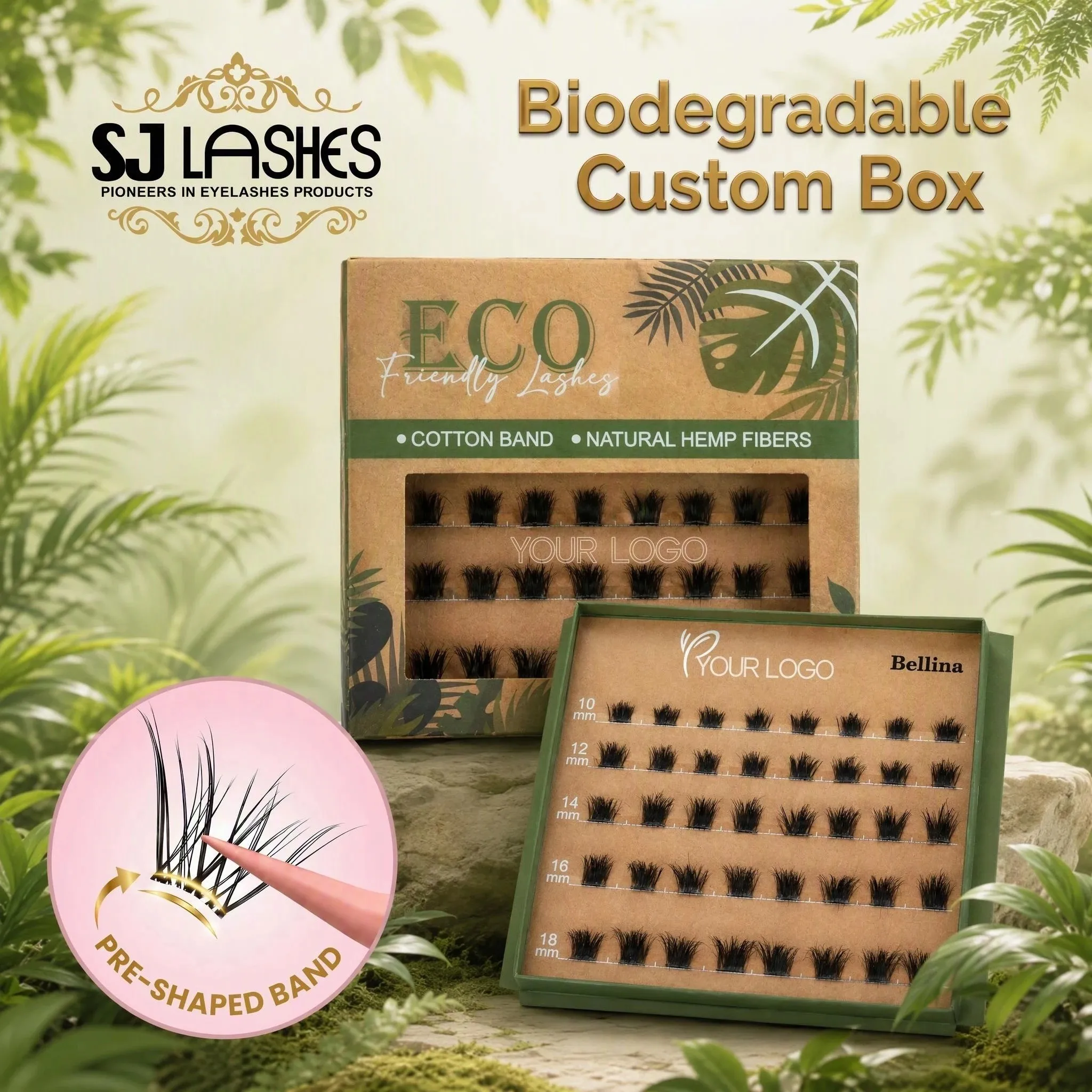
Image title: The Millimetre Ladder — a Box That Doubles as a Reorder Sheet
Why the pre-curved band suits this box
The eco box is built around the same 3D pre-curved band as our other segment formats, and the pairing is not arbitrary.
A pre-curved band is a lash cluster whose band is formed to a set radius before it reaches the customer, rather than arriving flat and relying on the user to bend it against the eyelid. The radius is commonly described by its R angle — the curvature matched to the lash line, so the band sits down along its whole length rather than only at the centre.
That matters for an eco product for a reason that is easy to miss: a band that fits gets reused, and a band that does not gets thrown away. The most significant sustainability gain in a DIY lash product is not in the board at all — it is in whether the customer wears the set more than once. A curved band that sits correctly on the first attempt is a retention feature, and retention is the environmental story that actually holds up.
The material band on the front panel supports the same story from the other direction, naming the band and fibre content rather than asserting a benefit.
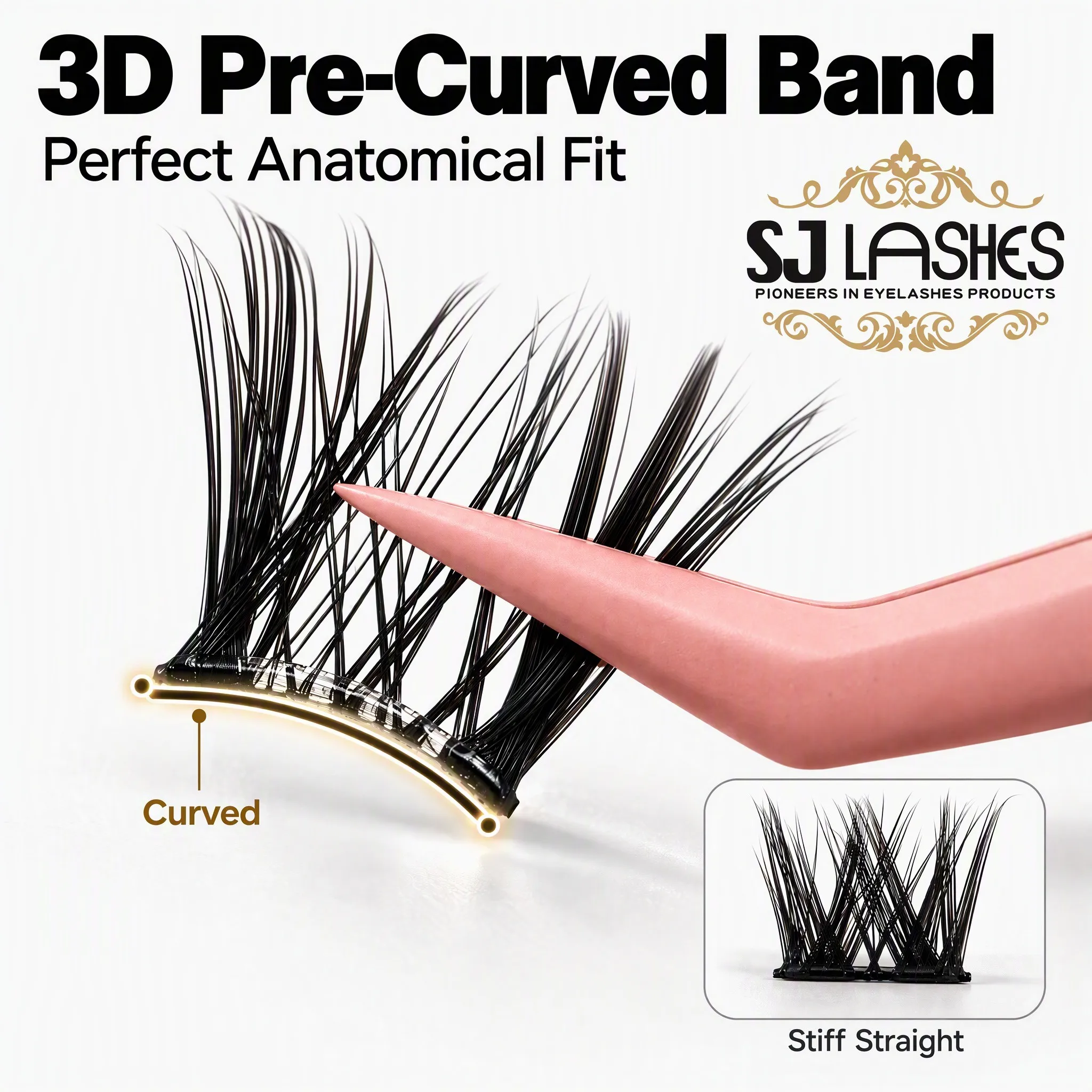
Image title: Curved Above, Stiff Straight Below — and the Curved One Gets Worn Twice
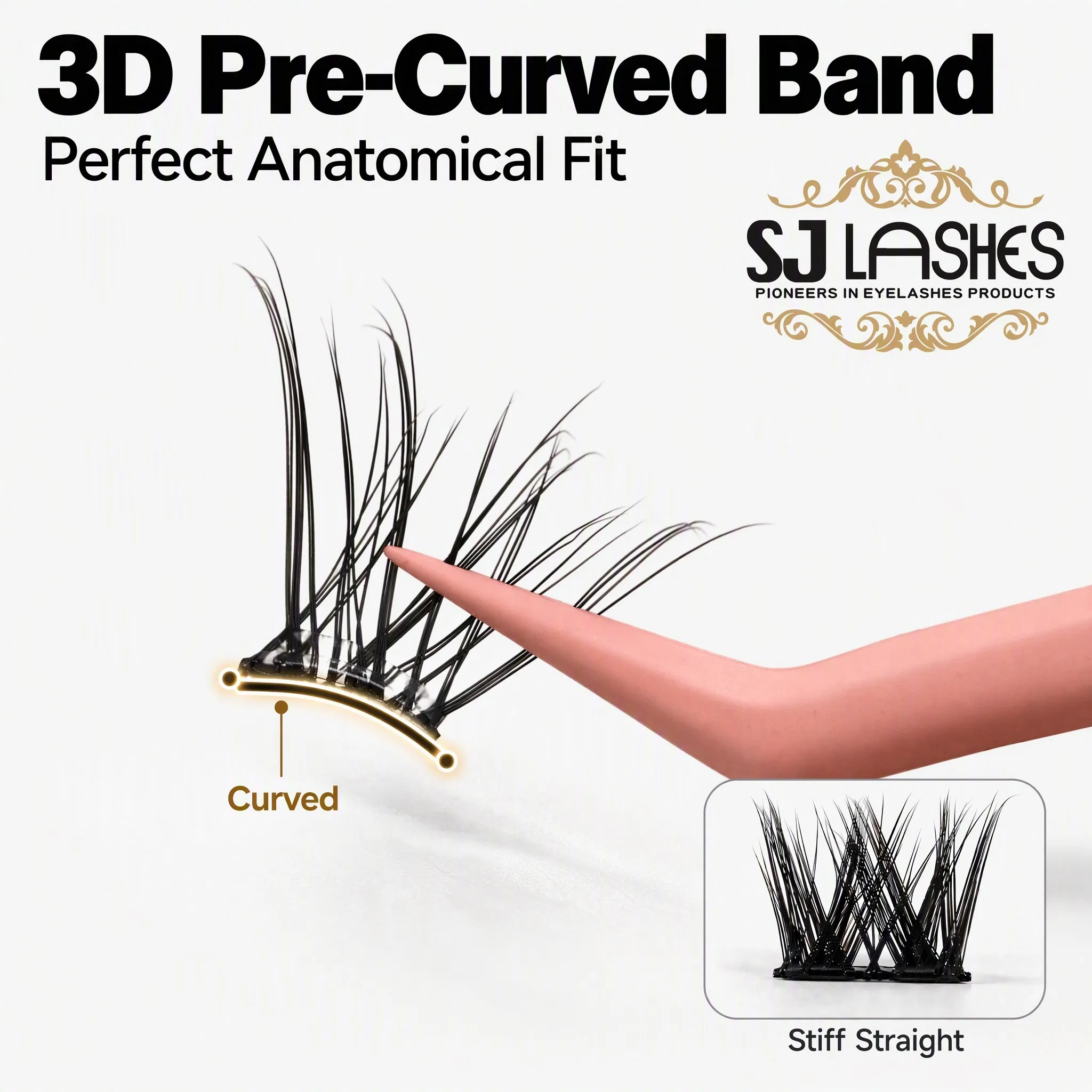
Image title: The R Angle Is the Retention Story, Not Just the Fit Story
The claim problem: where an eco box breaks
This is the section most suppliers will not write, and the reason this guide is worth reading.
An eco box has four components a customer has to deal with. Only one of them is usually sustainable by default.
| Component | Typical default | Why the claim can break |
|---|---|---|
| Board | Unbleached kraft | Usually the strongest part of the claim — but sourcing and certification still matter |
| Window film | Clear PVC | PVC is not biodegradable and complicates recycling |
| Tray or card | Often synthetic or mixed | A synthetic tray inside a paper box is the classic hidden inconsistency |
| The lash itself | Synthetic PBT fibre | The product outlives the box; the fibre is not the board |
A customer who reads "biodegradable" on the front panel and then finds a plastic window inside has a legitimate complaint — and under Directive 2024/825, so does a regulator.
The design rule that follows: decide what you are actually claiming, and make every component agree with that claim. If you cannot make the window agree, change the claim rather than the wording of the claim.
What changed on 27 September 2026
Three regimes matter for an eco lash box, and they are not the same thing.
1. EU Directive 2024/825 — environmental claims
Applies from 27 September 2026. Two provisions land directly on eco packaging:
- Broad environmental claims without substantiation are prohibited. This is the provision that covers "eco-friendly", "green" and "sustainable" used as general descriptors rather than specific, evidenced statements.
- A claim may not be presented as applying to the whole product when it applies only to part of it. This is the provision that catches a biodegradable box with a PVC window.
The practical effect: the material band on this box — naming cotton band and natural hemp fibres — is the safer pattern, because it states a specific material rather than a general virtue.
2. Compostability standards — EN 13432
Compostable is a defined technical claim, not a synonym for paper. In Europe the reference standard for industrially compostable packaging is EN 13432, and a compostability claim should be backed by certification and documentation the supplier can produce on request.
Two nuances worth knowing:
- Compostable and biodegradable are not interchangeable. A material can biodegrade without meeting compostability criteria, and vice versa.
- PLA behaves differently depending on the environment. PLA is industrially compostable under EN 13432 conditions, but it does not biodegrade in soil, in marine environments or in a home compost heap. If you are considering a plant-based window film as a substitute for PVC, that distinction is the whole decision.
3. Fibre sourcing and PPWR
FSC is the best-known forest certification, and there is a labelling rule attached: only chain-of-custody certificate holders may apply the FSC mark on-pack, and the artwork must follow the trademark standard. If your board is certified but your printer is not, you cannot put the mark on the box.
Separately, the EU's Packaging and Packaging Waste Regulation requires packaging to be recyclable in an economically viable way by 2030, with design-for-recycling criteria phasing in. A window film that cannot be separated from the board is the kind of design detail that becomes a problem under that regime.
All three regimes are still being implemented and national transposition differs. Confirm the specifics for your market with your compliance adviser and your printer before the print run.
How to make the components agree
Nine decisions, in the order that saves the most rework.
- Write the claim first, in one sentence. For example: "kraft board from certified sources, no plastic lid." Then check every component against that sentence.
- Choose the window film deliberately. PVC is the default and the weakest link. Ask what alternatives your supplier can actually run, and what each one can and cannot claim.
- Keep the tray and card paper-based where possible. A paper or card tray inside a paper box is a coherent pack; a synthetic tray is the inconsistency a customer finds first.
- Be precise about scope. "Board is industrially compostable per EN 13432" is defensible. "Biodegradable" alone, as a headline over a box containing film and synthetic fibre, is not.
- Put the evidence on the artwork, not only in the sales deck. If a material is certified, say so on the pack — a specific, evidenced line is more persuasive than a broad adjective and carries far less risk.
- Check who can legally print the marks. Certification marks have artwork and licence rules. Confirm your printer's status before designing the mark into the layout.
- Design for separation. If the film stays, make sure a customer can separate it from the board easily — that is what makes the box recyclable in practice, not just on paper.
- Do not claim for a component you do not control. If the lash fibre is synthetic, do not let the box imply the whole set is natural. Name the parts that are.
- Keep the material band updated. The band on this box names cotton band and natural hemp fibres. If a specification changes, the band has to change with it — a stale material claim is worse than no claim.
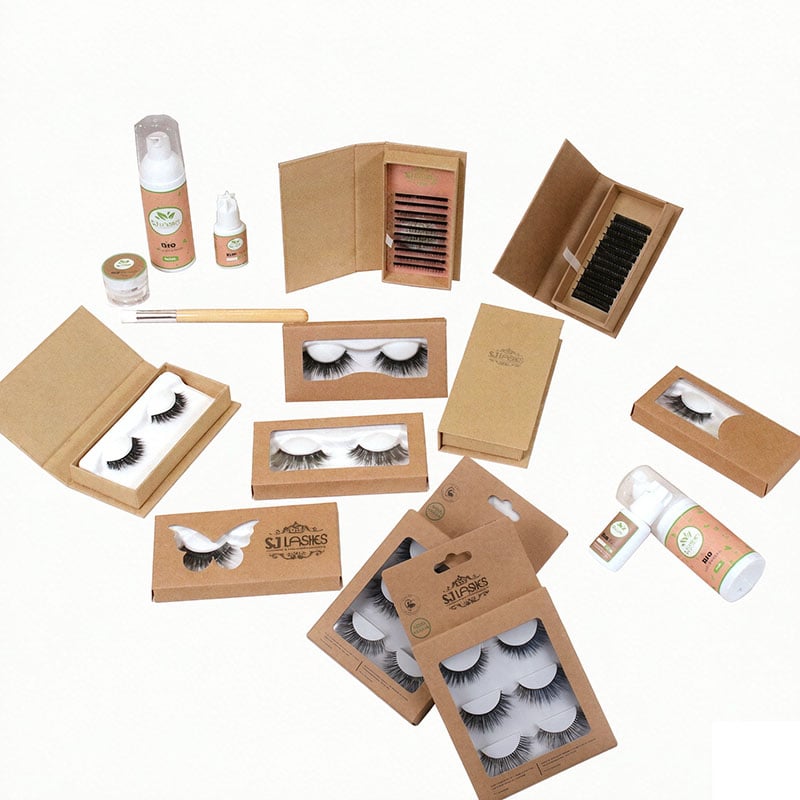
Customization options
- Board and finish — kraft stock and finish weight, printed into the board or with a controlled overprint.
- Window shape and size — aperture cut to show full rows or a single segment, with the film specified to suit your claim.
- Print colours — CMYK for complex artwork, Pantone spot for brand colours, including the green used for the material band.
- Frame colour — the tray or card frame can be re-coloured without changing the board stock.
- Band wording — the material band text is customizable, and should match your verified specification.
- Millimetre ladder — which lengths are printed, in what increments, and where they sit against the rows.
- Logo placement — outline over the window, script on the card, or both.
- Row count and lash style — from a compact set up to the five-row ladder configuration.
- Structure options — folding cartons on coated art paper from 250gsm to 350gsm, or specialty kraft and textured stocks; rigid boxes from 1.5mm to 2.0mm where the format calls for it.
👉Explore our cluster lashes paper boxes range and our full custom packaging service.
Supplier scorecard and sampling
What to ask
- What is the board, and can you supply certification documentation for the fibre source?
- Which window films can you run, and what can each one claim — and not claim?
- Is the tray or card paper-based, and can it be made so?
- Can you print a multi-line material band legibly at final size?
- Can you print a millimetre ladder beside the rows, and how fine can the type be?
- Does your print process allow certification marks to be applied on-pack, and are you licensed to do so?
- Can the frame colour change without re-specifying the board?
- What documentation accompanies a shipment — certification, material declarations, artwork files?
What to check on the sample
- Component audit. Lay out board, window, tray, card and product. For each one, ask: does this agree with the claim on the front panel?
- Band legibility. Read the material band at arm's length under retail lighting.
- Ladder legibility. Read the millimetre values the way a customer would, with the box in one hand.
- Naked-eye separation. Can you separate the film from the board without tools?
- Board integrity. Check the kraft surface after folding, for scuffing and cracking at the creases.
- Claim test. Read your own front panel as a sceptical customer would, then as a regulator. If either finds a gap between claim and contents, fix the components, not the sentence.
Channel notes
Clean and vegan beauty. This is the natural home for the format. The material band does the work that a "natural" colour palette only gestures at, and it survives comparison shopping.
Marketplace and DTC. Consumers actively look for material information on eco listings. The material band and the millimetre ladder photograph well as detail shots, and they answer questions that would otherwise become returns.
Retail and salon. The kraft surface reads as a considered product rather than a cheap one, provided the board weight is right. Under-weight kraft folds soft and undoes the whole aesthetic.
Refill and reorder. The millimetre ladder makes single-length reorders possible, which is the most natural repeat-purchase mechanic in this category and costs nothing but print.
OEM workflow
- Draft the claim sentence — one sentence, specific, covering only what you control.
- Choose components that satisfy it — board, film, tray, card, and product fibre where you control it.
- Confirm certification and licensing — fibre source documentation, and whether your printer may apply any certification marks.
- Design the band and the ladder — material wording checked against the verified specification, millimetre values set against the actual rows.
- Physical sample and claim test — the component audit and the sceptical-reader test.
- Produce and archive — board, film and frame specifications recorded so a reorder does not silently change what the pack claims.
Quote request checklist
- Target market and channel.
- The claim sentence you intend to make, and which components it covers.
- Board type and any certification requirement.
- Window requirement, and preferred film.
- Tray or card material and frame colour.
- Print colours, including the material band colour.
- Material band wording, verified against your specification.
- Millimetre ladder — which lengths, which increments.
- Logo treatment and placement.
- Row count and lash style.
- Sample quantity, first order quantity, and delivery window.
👉Request a free sample and quote for your kraft eco lash box
Compliance checklist
- Substantiate every environmental claim. Broad unsubstantiated claims are prohibited under Directive 2024/825 from 27 September 2026.
- Scope your claim to what it actually covers. A claim may not imply it applies to the whole product when it applies only to part of it.
- Back compostability with certification. EN 13432 is the European reference standard for industrially compostable packaging; keep the documentation available.
- Do not treat compostable and biodegradable as synonyms, and do not assume a plant-based film composts at home — PLA is industrially compostable but not home compostable.
- Respect certification mark licensing. Only chain-of-custody certificate holders may apply the FSC mark on-pack, and artwork must follow the trademark standard.
- Design for recyclability. PPWR requires packaging to be recyclable in an economically viable way by 2030; a film fused to board works against that.
- Keep material claims current. If a specification changes, the band wording changes with it.
- Keep cosmetic labelling obligations in view. If the pack is sold with a liquid or adhesive, those components carry their own labelling requirements independent of the eco claim.
Requirements differ between markets and transposition is ongoing. Confirm the final content and claims for your target market with your compliance adviser before the print run.
Why SJ LASHES
- Board, window, tray and lash from one factory — which is what makes it possible to align the components with the claim instead of discovering the mismatch after printing.
- Kraft print expertise — artwork printed into the board rather than flooded over it, so the natural surface stays visible.
- Multi-line material bands and ladders printed cleanly at final size.
- Frame colour changes without a board change, so a re-colour does not mean a re-specification.
- Pre-curved band know-how across 3D pre-curved bands, R-angle fit and multi-length ladders from 10mm to 18mm.
- Honest specification support — we will tell you which components cannot support a claim, because a claim that fails costs you more than a box that under-promises.
- Low MOQ with fast sampling for a first eco run.
See our cluster lashes paper boxes, all-in-one packaging and magnetic lashes ranges, or read more packaging guides on the SJ LASHES blog.
FAQ
Is a kraft lash box automatically biodegradable?
No. The board is usually the most defensible part of the claim, but a box also contains a window film, a tray or card, and the product itself. If any of those components does not agree with the claim, the claim does not hold for the pack.
What is the difference between biodegradable and compostable on packaging?
Compostable is a defined technical claim, and in Europe the reference standard for industrially compostable packaging is EN 13432, which requires certification and documentation. Biodegradable is a broader term and is not interchangeable with it. Using the two loosely is where eco packaging claims most often fail.
Does a plant-based window film solve the problem?
Only if you match the film to your claim. PLA, a common plant-based option, is industrially compostable under EN 13432 conditions but does not biodegrade in soil, in marine environments or in a home compost heap. A windowless design or an easy-to-separate film may suit your claim better than a substitute film.
What does the material band on the front panel do?
It names what the product is made of — cotton band, natural hemp fibres — instead of asserting a general virtue. That is more persuasive to a customer and considerably safer under the environmental claims rules now in force, because it states a specific material rather than a broad adjective.
What is the millimetre ladder for?
It is a row of length values printed down the card — 10mm to 18mm beside five rows of segments. It turns the box into a reorderable map, so a customer can buy the single length she actually uses rather than repeating the whole set. It is a repeat-purchase feature that costs nothing but print.
Why does the pre-curved band matter on an eco product?
Because a band that fits gets worn more than once. The largest sustainability gain in a DIY lash product is not in the board — it is in whether the customer reuses the set. A 3D pre-curved band that sits correctly on the first attempt supports that directly.
Can I print an FSC mark on my lash box?
Only if the licence conditions are met. Only chain-of-custody certificate holders may apply the FSC mark on-pack, and the artwork has to follow the trademark standard. Confirm your printer's status before you design the mark into the layout.
What is the minimum order for a custom kraft eco lash box?
It depends on board type, window and film specification, frame colour and finishing. Share your claim sentence and target quantities and we will confirm what is achievable for a first run.
Where this sits in the family
This kraft eco box and the pink segmented lash box are the two directions we have documented so far, and they are built for different briefs. The pink box is engineered to protect and display a curve for a beginner-friendly retail launch. The kraft box is engineered to make a material claim hold up once every component is counted.
There is a third in the same family — the purple slide-out box, a rigid drawer construction with a satin-lined tray and size-labelled S/M/L/XL rows, aimed at the gift and premium retail end. That guide is still to come.
👉Request a free sample and quote from SJ LASHES
For more packaging development, factory footage and application education, follow SJ LASHES on Instagram and read the SJ LASHES blog.